
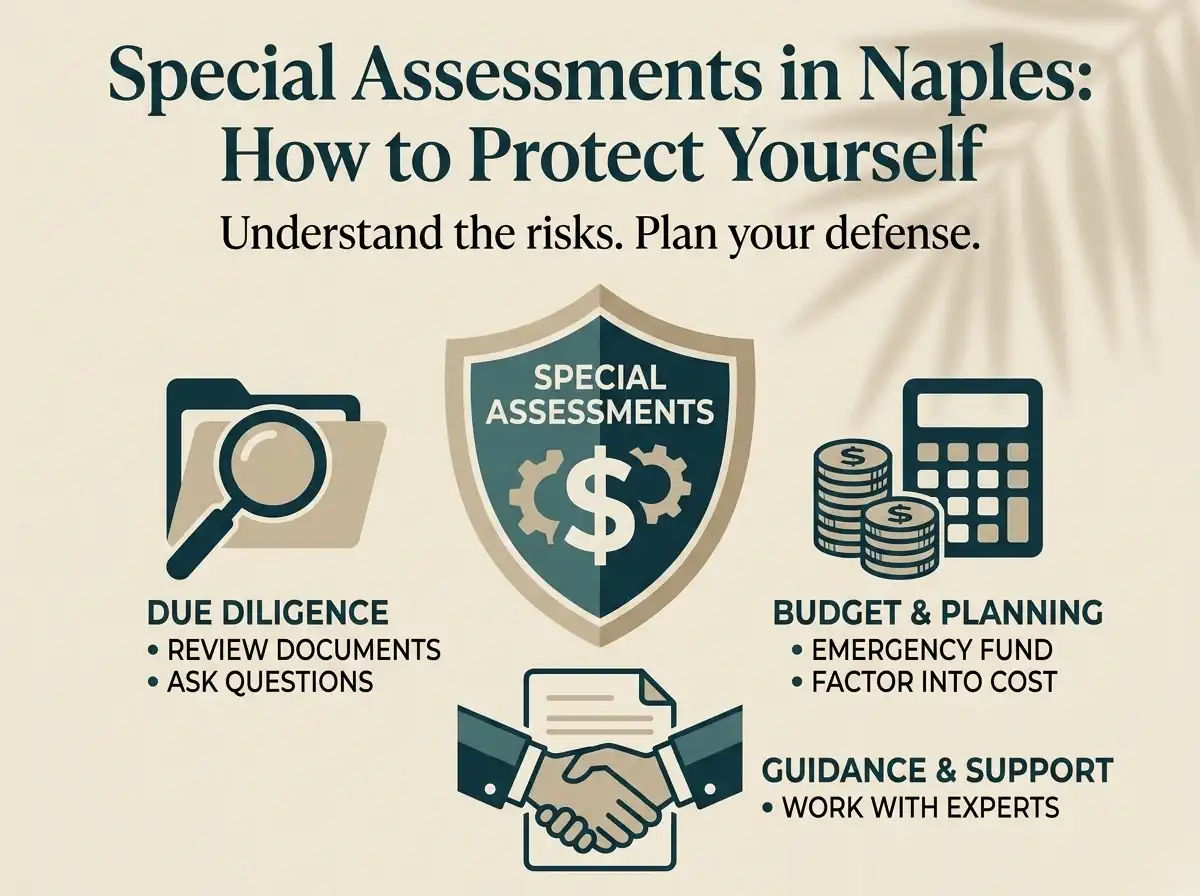
Special Assessments in Naples — How to Protect Yourself Before You Close
A special assessment can turn a great deal into a five-figure surprise. This guide covers what they are, why they happen constantly in Naples condos, and exactly how to protect yourself before you sign anything.
What a Special Assessment Actually Is
A special assessment is a one-time charge an HOA or condo association levies on owners when the regular budget and reserve funds are not enough to cover a major expense. It is not your monthly dues. It is not a fee you can opt out of. It is more like receiving a letter that reads: "We need $2.4 million for roof and concrete restoration, reserves are short, your unit's share is $18,500, due in 60 days."
Sometimes payment plans are available. Sometimes the association takes out a loan and your monthly dues increase to service it. Either way, owners pay. If you close on a condo and an assessment is approved two weeks later, you pay it — regardless of whether the seller knew it was coming.
The most common causes in Naples:
- Roof replacement — especially after storms or age-related failure
- Structural concrete repairs, balcony restoration, waterproofing
- Seawall repairs and marina work
- Elevator modernization and major mechanical systems
- Insurance premium spikes that blow up the operating budget
- Deferred maintenance that finally becomes unavoidable
- Code compliance, fire suppression upgrades, and post-Surfside structural requirements
Why Naples Has More Special Assessments Than Most Markets
Naples has an enormous inventory of older condos — many built in the 1970s, 1980s, and 1990s. The physical environment is punishing: salt air, intense sun, humidity, water intrusion, and periodic hurricane damage all accelerate structural wear. Buildings that look well-maintained on the surface can have significant deferred maintenance hiding in reserve fund shortfalls.
The deeper problem is that many associations kept dues artificially low for years to make units look more attractive on the market. Low HOA fees are a selling point — until the roof fails and reserves can't cover it. Then every owner gets a bill.
Post-Surfside legislation has also pushed many Florida condo associations to complete Milestone Inspections and Structural Integrity Reserve Studies that they previously avoided. Those inspections are surfacing required repairs that boards can no longer defer. The result is a wave of special assessments across Collier and Lee Counties that will continue through the late 2020s.
The Two Most Dangerous Times to Get Caught Off Guard
Right after closing. The board was "discussing" a large repair project. The vote hadn't happened yet. You closed. Two weeks later the vote passes and a $15,000 assessment is billed to every unit. You own it now. This scenario is more common than buyers realize — and it is almost entirely preventable with the right document review.
When a seller says "no current assessments." That statement can be technically accurate and still completely misleading. There may be no assessment billed today. But the roof engineering report may already be in. The reserve study may already show a $2 million shortfall. The board may already have collected three contractor bids. The assessment is loading — it just hasn't posted yet. Asking about current assessments is not enough. You need to ask about what is being discussed, planned, and anticipated.
Seven Documents to Review Before You Close on a Naples Condo
This is where buyers protect themselves. Not by guessing, not by asking the seller, but by reading the actual documents. Your agent should request all of these during the inspection period.
| Document | What to Look For |
|---|---|
| Current year budget | Are operating expenses realistic? Is the reserve contribution adequate relative to building age? |
| Most recent financial statements | Balance sheet and income statement. How much cash is actually in reserves vs. what the budget projects? |
| Reserve study or reserve schedule | Percent funded. Anything below 70% funded is a yellow flag. Below 50% is a red flag. |
| HOA/condo estoppel certificate | Confirms dues, arrears, and sometimes pending or approved assessments. Required at every closing. |
| Meeting minutes — 12 months minimum | The gold mine. Look for: roof discussions, engineer reports, contractor bids, reserve shortfall mentions, "exploring financing options." |
| Milestone Inspection / SIRS report | Required for many Florida condos post-Surfside. Shows structural findings and recommended repairs. |
| Insurance summary | Carrier, premium trend, deductible amounts. Large deductibles (e.g. 5% hurricane) become owner costs in a claim. |
Meeting minutes deserve special attention. Buyers skip them because they are long and boring. That is exactly why they are valuable — boards speak more candidly in minutes than in any other document. Phrases like "discussed need for concrete restoration," "received three bids for roof replacement," or "reserve shortfall noted" are the signals that an assessment is coming, even if nothing has been approved yet.
Questions to Ask the HOA or Management Company Directly
Vague questions get vague answers. Specific questions are harder to dodge. If your agent or attorney can submit these in writing to the HOA management company, even better — written responses create a paper trail.
- Are any special assessments currently approved, proposed, or under active discussion by the board?
- What major repair or replacement projects are planned or anticipated in the next 12 to 36 months?
- Are reserves fully funded per the most recent reserve study? If not, what is the board's plan to address the shortfall?
- Has the association had any insurance premium increases in the last two years, and how have those been handled?
- Is there any open litigation involving the association?
- Does the association have any outstanding loans? If yes, what are the terms?
- Has the Milestone Inspection been completed? What repairs were identified and what is the timeline for addressing them?
Hesitation, vague responses, or deflection are signals — not proof of a problem, but reason to dig further before proceeding.
Contract Protections Buyers Can Negotiate
The goal is not to make the transaction adversarial. The goal is to not be the buyer who funds a project the seller knew was coming. These are common and reasonable protections — an experienced Naples agent will know how to frame them without killing the deal.
- Seller pays any assessment approved before closing — even if the payment schedule extends after closing. This is the most important protection to negotiate when a project is known to be pending.
- Full disclosure requirement — seller must disclose any known pending special assessments, major repair discussions, or engineering reports identifying required work.
- Document review contingency — buyer's obligation to proceed is contingent on receiving and approving all condo documents, including meeting minutes and reserve study.
- Credit at closing — if reserves are materially below the funded percentage stated in the reserve study, a credit to the buyer at closing reflects that risk in the price.
Red Flags That Should Slow You Down
None of these are automatic deal-killers. Each one is a reason to dig further before proceeding — not to panic, but to get clear on what you are buying into.
- Reserves funded below 50–60% relative to building age and amenities
- HOA dues materially lower than comparable buildings nearby — artificially low dues often mean underfunded reserves
- Casual mention of major upcoming projects: "We're looking at the roof next year"
- Insurance carrier changes, large premium jumps, or unusually high deductibles
- Visible deferred maintenance in common areas — peeling paint, stained ceilings, aging pool equipment
- History of consecutive special assessments in the past 5 years
- Milestone Inspection completed but recommended repairs not yet addressed or funded
If You Are Selling a Condo With a Pending Assessment
The worst thing sellers do in this situation is hide it. Buyers who discover an undisclosed assessment after closing — or worse, after their attorney reviews the minutes — almost always walk or demand a significant price reduction. Transparency early keeps deals intact.
If an assessment is pending or likely, gather the documentation early. Price the home with the situation disclosed, not around it. A buyer who understands the full picture is far more likely to close than one who discovers it mid-contract. And with our 1% listing commission, sellers have more room to negotiate credits or price adjustments without their net proceeds collapsing.
HOA fees, CDD, insurance, taxes, and potential assessments — see the real monthly cost of any Naples property before you make an offer.
Open CalculatorScott reviews HOA financials, reserve studies, and assessment risk on any Naples condo before you write an offer. Free, no obligation.
Talk to ScottAbout the Author

Scott Cowan Broker / Owner — Realty of Naples FL Scott Cowan is the broker and owner of Realty of Naples FL — a licensed real estate brokerage with offices in Florida, New Jersey, and New York. With nearly 35 years of experience and over $100,000,000 in closed transactions, Scott brings a depth of market knowledge that few Naples agents can match.