
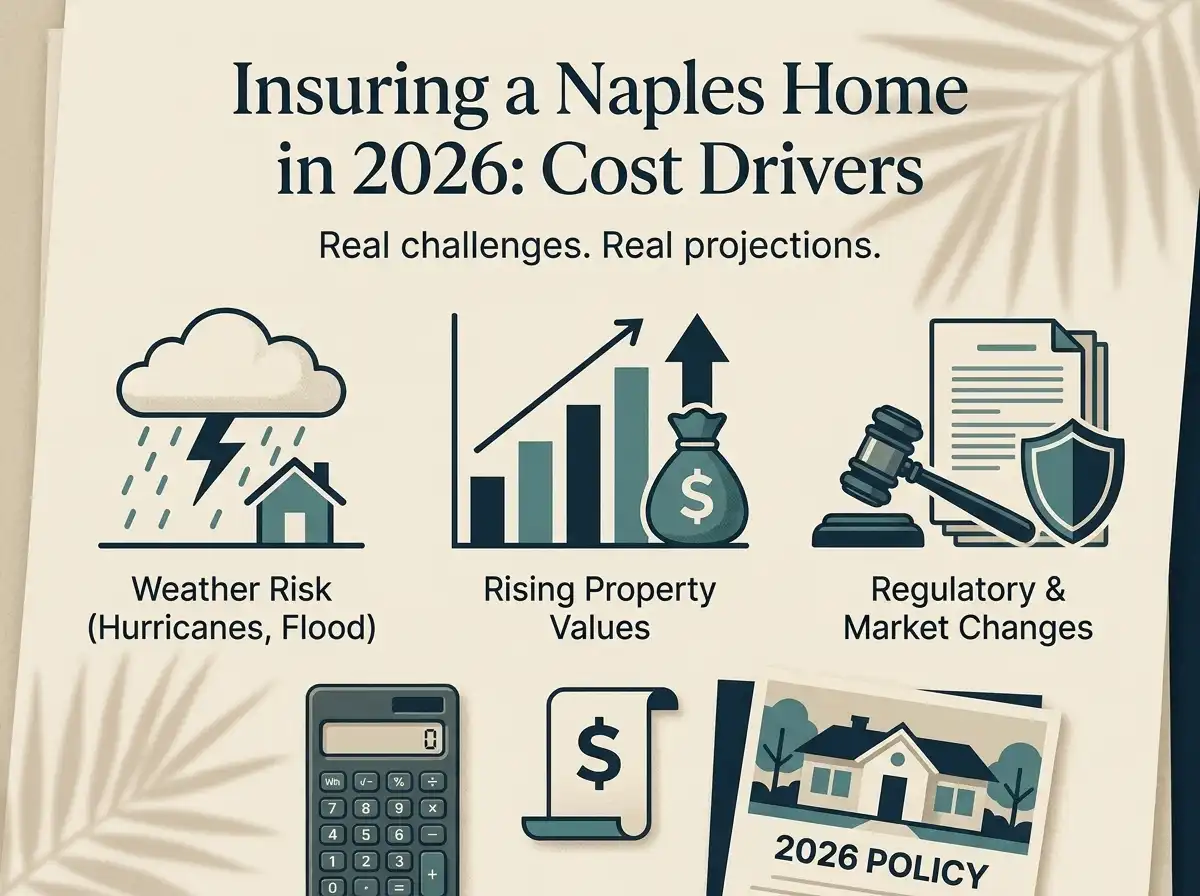
Insuring a Naples Home in 2026 — The Real Cost Drivers
Florida insurance is not like insurance anywhere else. The cost levers are different, the documentation requirements are stricter, and the surprises hit hardest when you are buying or selling. This guide covers the ten factors that actually drive your Naples premium — and what you can do about each one.
Why Naples Insurance Requires a Different Framework
Homeowners arriving in Naples from the Northeast often base their insurance cost expectations on prior experience — a $600–$1,200/year premium for a comparable home in Connecticut or New Jersey. In Naples, the same home can cost $6,000–$18,000/year or more to insure, and that range varies enormously based on factors that are specific to Florida and to Collier County in particular. Understanding which factors drive the number — and which ones you can actually influence — is the difference between managing insurance as a known cost and discovering it as a shock.
The Florida insurance market in 2026 is also structurally different from prior years. Carrier exits, reinsurance cost increases, post-storm claim patterns, and legislative changes have collectively reduced the number of carriers willing to write Collier County policies and narrowed the conditions under which they will do so. This means that underwriting criteria are stricter, documentation requirements are more demanding, and the gap between a well-documented home and a poorly-documented home is wider than it used to be.
| Cost Driver | Premium Impact | Owner Control |
|---|---|---|
| Replacement cost / dwelling limit | High — sets the base for every other calculation | Moderate — review and calibrate annually |
| Roof age, type, and documentation | Very high — can determine insurability, not just price | High — replace, document, and report improvements |
| Wind mitigation features and report | High — credits can reduce wind premium significantly | High — update report when improvements are made |
| Flood zone and elevation | High — separate policy, can range from $500 to $5,000+/yr | Low — fixed by location; elevation certificate helps |
| Hurricane deductible structure | High — percentage deductibles on high-value homes are large | Moderate — structure is negotiable at binding |
| Prior claims history | Moderate to high — water claims especially scrutinized | Moderate — document repairs thoroughly |
| Home age and building systems | Moderate — electrical, plumbing, HVAC age matter | High — document all system upgrades with permits |
| Distance to fire response | Low to moderate — part of underwriting formula | None — fixed by location |
| Policy form and coverage terms | Moderate — determines what actually pays out | High — compare forms, not just premiums |
| Transaction timing and urgency | Moderate — rushed binding produces worse terms | High — get quotes in week one of inspection period |
Driver 1 — Replacement Cost Is Not Your Market Value
Insurance Coverage A — the dwelling limit — is based on what it would cost to rebuild your home today from the ground up, not what your home would sell for on the open market. In Naples, these numbers can diverge significantly. A home with a market value of $900,000 may have a rebuild cost of $650,000 because the land value accounts for a large portion of the market price. Conversely, a home with luxury finishes and complex architecture may have a rebuild cost that exceeds its market value in a soft market.
The Naples-specific variables that push rebuild costs higher than national averages: labor costs in a market with significant contractor demand, the cost premium for hurricane-resistant construction materials, code upgrade requirements that trigger when more than a certain percentage of a structure is rebuilt, and demand surge pricing in the aftermath of a major storm when every contractor in the region is simultaneously booked.
An underinsured dwelling limit means a gap between your claim payout and your actual rebuild cost — a gap you fund out of pocket. An overinsured limit means you are paying premium on coverage above what the structure is worth. Review your Coverage A limit annually against current local construction cost benchmarks, not the number that was set at binding three years ago.
Driver 2 — Roof Age, Type, and Documentation
In the Naples insurance market, the roof is the single most consequential property characteristic. Carriers in Florida have become progressively stricter about roof age thresholds, and in 2026 some carriers will not write a new policy on a home with a roof over a certain age regardless of its condition. This is not a negotiable underwriting guideline — it is a portfolio management decision driven by actuarial data on where claims originate.
What underwriters evaluate on a Naples roof:
- Age: many carriers have hard cutoffs at 10, 15, or 20 years depending on material. Concrete tile roofs receive more favorable treatment than shingle roofs at equivalent ages.
- Material: metal roofing generally receives the most favorable treatment. Concrete tile is well-regarded. Shingle roofs in coastal markets face more scrutiny. Flat and modified bitumen roofs on additions require separate evaluation.
- Documentation: permits for the installation or replacement, invoice from the roofing contractor, and any subsequent inspection reports. In the absence of documentation, underwriters assume worst case.
- Condition: a roof that is technically within an acceptable age range but shows visible deterioration — missing tiles, granule loss, flashing issues — can still trigger underwriting concerns or require a roof inspection before binding.
If you have replaced your roof, upgraded roofing materials, or made repairs since your last policy renewal, notify your agent and provide documentation. This is not automatic — the insurer will not discover your improvements unless you report them with supporting evidence.
Driver 3 — Wind Mitigation Features and the Wind Mit Report
Florida law requires insurers to provide premium credits for homes with verified wind mitigation features. The wind mitigation report — completed by a licensed inspector — documents those features and provides the evidence insurers need to apply those credits. For Naples homes with qualifying construction, a current wind mitigation report is one of the highest-return documentation investments available.
The features that produce the largest credits:
- Opening protection: impact-rated windows and doors, or code-compliant storm shutters covering all openings including garage doors. This is typically the largest single credit category.
- Roof-to-wall connections: double wraps provide better credits than single wraps; clips provide better credits than toe-nails. This is a structural characteristic of the original construction that cannot be changed without significant work, but needs to be accurately documented.
- Roof deck attachment: the nail size and spacing pattern used to attach the roof deck to the trusses. Better attachment methods reduce the likelihood of deck loss in a wind event.
- Roof shape: hip roofs (four slopes meeting at a ridge) perform better than gable roofs in wind events and receive favorable treatment.
- Secondary water barrier: a water-resistant barrier beneath the roof covering that reduces interior water intrusion if the primary covering is damaged.
If your wind mitigation report is more than a few years old, or if you have replaced windows, upgraded doors, or re-roofed since the last inspection, get an updated report. The credits apply to the wind portion of your premium — which in a coastal Florida market is a substantial share of the total cost.
Driver 4 — Flood Risk and the "Not in a Flood Zone" Trap
Standard homeowners insurance does not cover flood damage. This distinction — which is obvious to experienced Florida homeowners and invisible to buyers arriving from the Northeast — has produced some of the most costly post-storm discoveries in Collier County's history. A home can sustain significant storm surge or rainfall flooding and receive zero dollars from a homeowners claim if the damage is flood-related and the owner carries no flood policy.
FEMA flood zone designations identify areas with the highest statistical flood risk, but they do not capture all flood risk. Naples homes outside designated Special Flood Hazard Areas have flooded in multiple storm events due to drainage limitations, canal overflow, low-lying topography, and the sheer volume of water that Southwest Florida can receive during a named storm. Being outside the required zone means no lender mandate — it does not mean no flood exposure.
Flood insurance pricing variables that matter for Collier County properties:
- Elevation certificate: documents the lowest floor elevation relative to the Base Flood Elevation. Properties above BFE receive lower NFIP rates; the elevation certificate makes that credit verifiable.
- First floor finish level: a home with expensive tile, cabinetry, and finishes at ground level has a higher flood loss exposure than a home with utility finishes at the same elevation.
- Building vs contents coverage: NFIP policies separate structure and contents — both need to be evaluated against replacement cost.
- Private flood market: in 2026, the private flood insurance market offers alternatives to NFIP that may provide broader coverage, higher limits, or better pricing depending on the specific property risk profile.
Driver 5 — Hurricane Deductibles and Percentage Shock
Florida homeowners policies typically carry two separate deductibles: an all-other-perils deductible (a flat dollar amount) and a hurricane deductible (expressed as a percentage of the Coverage A dwelling limit). The hurricane deductible applies to losses caused by a named hurricane and is almost always larger — often significantly larger — than the all-other-perils deductible.
The practical impact is substantial at Naples home values. A 2% hurricane deductible on a $900,000 dwelling limit is $18,000 out of pocket before coverage applies to any hurricane damage. A 5% deductible on the same home is $45,000. These numbers are not hypothetical — they represent the actual first-dollar exposure for a Naples homeowner in a named storm event.
Carriers frequently offer lower annual premiums in exchange for higher hurricane deductibles. This trade-off can make sense for cash-reserve-rich homeowners who can absorb a large deductible without financial stress. It is the wrong trade for homeowners who could not write that check comfortably after a storm. Evaluate the premium difference against your realistic ability to fund the deductible — not against the abstract probability of a hurricane.
Driver 6 — Prior Claims History
Insurance claims follow a property and follow an owner. A home with a history of water claims — even small ones that were properly remediated — signals to underwriters a pattern of water intrusion risk that may persist. Non-weather water losses (supply line failures, appliance leaks, drain backups) are particularly scrutinized in Florida because they represent frequency risk rather than severity risk — meaning the property is likely to generate future claims regardless of storm exposure.
The most important thing a Naples homeowner can do after any claim — small or large — is document the remediation completely. Carrier-certified remediation, licensed contractor invoices, mold clearance testing if applicable, and any structural repairs made. An insurer reviewing a prior claim that has complete remediation documentation assesses a closed risk. An insurer reviewing a prior claim with no remediation documentation assesses an open one.
For buyers: request the CLUE (Comprehensive Loss Underwriting Exchange) report on any Naples property before purchasing. This report documents the claim history for the property and is material to your insurance cost and insurability assessment. Your agent can help obtain this during the due diligence period.
Driver 7 — Home Age and Building Systems
Naples has housing stock ranging from post-war construction to brand-new builds, and the insurance market prices that range accordingly. A beautifully renovated older home with cosmetic updates but original electrical, plumbing, or structural systems will be priced based on the underlying system risk — not the new kitchen. Underwriters are evaluating what will fail and what will cost money, not what looks attractive in listing photos.
The building systems that most consistently affect underwriting in Naples:
- Electrical panel and wiring: Federal Pacific and Zinsco panels are flagged by many carriers as uninsurable or subject to surcharge. Knob-and-tube or aluminum branch circuit wiring similarly. If you have updated these, document with permits and inspection certificates.
- Plumbing supply lines: polybutylene piping is a coverage concern. Cast iron drain lines in older homes may require disclosure. Copper or CPVC documented with permits is favorable.
- HVAC age: units over 10–15 years are often noted in underwriting. Documented maintenance history and recent replacement extend the effective life in underwriting terms.
- Building code compliance: older homes that have not been substantially renovated may face code upgrade requirements if they sustain significant damage — the ordinance and law coverage endorsement addresses this specifically.
Driver 8 — Policy Form and Coverage Terms
Two Naples homeowners policies can have identical dwelling limits and annual premiums and pay out very differently after a loss. The policy form — what is covered, how it is valued, and what is excluded — is the substance of what you are actually buying. Premium comparison without form comparison is incomplete analysis.
The coverage terms that produce the most post-claim disputes in Florida:
- Roof settlement — actual cash value vs replacement cost: some policies settle roof claims at actual cash value, meaning the payout is depreciated based on roof age. A 15-year-old roof on a $900,000 home may receive a fraction of the replacement cost under an ACV roof settlement provision. Replacement cost coverage on the roof is worth the premium differential.
- Water damage sublimits: some policies cap non-weather water damage payouts at amounts well below the actual cost of a significant leak and remediation event. Know your sublimit before you need it.
- Ordinance and law coverage: pays the additional cost to bring a damaged structure into compliance with current building codes during repair. In Naples, where older homes may have substantially different requirements under current wind codes, this endorsement can represent tens of thousands of dollars of coverage gap.
- Screen enclosure coverage: standard in the Naples lifestyle; not standard in all policy forms. Confirm it is included and at adequate limits.
- Loss of use limits: pays for temporary housing during a covered repair period. In Naples, short-term rental costs during season can exceed $5,000–$10,000/month. Confirm limits reflect local rental rates.
Drivers 9 and 10 — Fire Response Distance and Transaction Timing
Fire response distance — proximity to a fire station and hydrant — is a standard underwriting variable that affects Naples premiums less dramatically than wind and water factors but still contributes to the formula. Properties in gated communities with private road access, or in areas where public fire response is more than five miles, may receive less favorable ratings on this element. It is not a controllable variable for most homeowners, but it is part of understanding why two similar properties price differently.
Transaction timing is the most controllable and most frequently mismanaged factor. Buyers who begin their insurance search in the final days of the inspection period are shopping under urgency — and urgency produces worse terms. Carriers know a rushed binding when they see one, and agents shopping for a buyer with a 48-hour deadline have fewer options and less leverage than those shopping with ten days of runway.
The correct approach: begin insurance research in the first week of the inspection period, not the last. If the property has characteristics that may present challenges — aging roof, coastal flood zone, older building systems — discovering those challenges early gives you time to either find workable coverage, negotiate with the seller for remediation, or make an informed decision about proceeding. Discovering them on day 13 of a 15-day inspection period produces bad outcomes.
Pre-Renewal and Pre-Sale Checklist
- Pull your declarations page — confirm Coverage A dwelling limit against current local rebuild cost benchmarks
- Confirm hurricane deductible percentage and calculate the actual dollar exposure at your current Coverage A
- Verify roof age, material, and whether permits and invoices are on file
- Check when your wind mitigation report was last updated — if improvements have been made since, schedule an updated inspection
- Obtain or update your elevation certificate if you are near a flood zone boundary
- Get a flood insurance quote regardless of whether you are in a required zone
- Document all system upgrades since last policy binding — electrical, plumbing, HVAC, roof, windows, doors
- Review policy form for roof settlement method, water damage sublimits, ordinance and law coverage, and screen enclosure inclusion
- If selling, pull the CLUE report and address any open documentation gaps before listing
- If buying, begin insurance research in week one of the inspection period — not week two
Compare estimated insurance costs across Naples communities — coastal, inland, condo, single-family — before you commit to a purchase.
Open ToolScott reviews insurance-related property characteristics for every Naples buyer and seller before the transaction — not as an afterthought. Free, no obligation.
Talk to ScottAbout the Author

Scott Cowan Broker / Owner — Realty of Naples FL Scott Cowan is the broker and owner of Realty of Naples FL — a licensed real estate brokerage with offices in Florida, New Jersey, and New York. With nearly 35 years of experience and over $100,000,000 in closed transactions, Scott brings a depth of market knowledge that few Naples agents can match.