
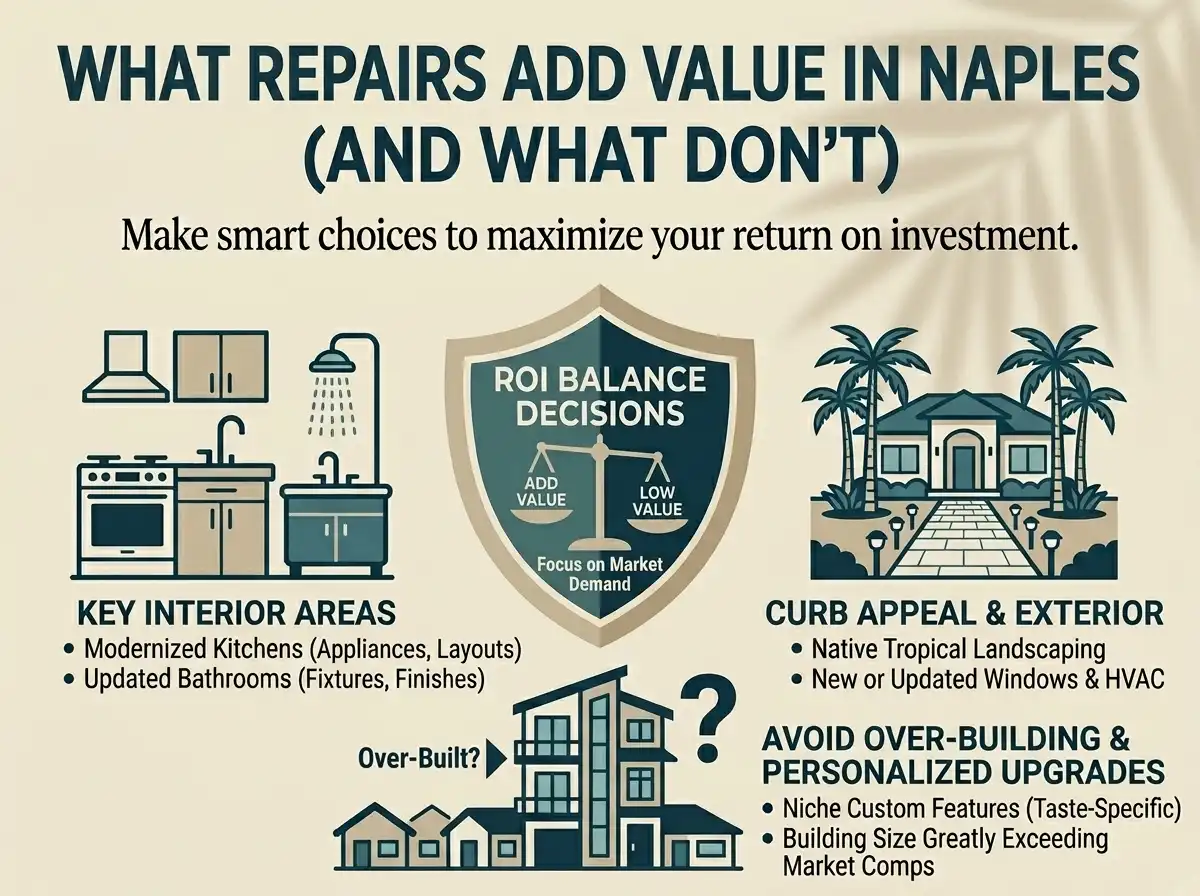
What Repairs Add Value in Naples Before You List — And What Don't
Some repairs pay back more than they cost. Some cost more than they recover. And some of the most expensive renovations sellers do before listing produce no measurable return at all. This guide covers the Naples-specific decision framework — what to fix, what to skip, and what buyers here actually care about.
How Value Actually Works When You Sell in Naples
There are two distinct types of value that pre-sale repairs affect, and conflating them is where sellers overspend. Appraisal value is driven by condition, the age and function of major systems, permit history, and comparable sales. Buyer value is driven by what creates confidence, reduces perceived risk, and makes a home feel move-in ready in the walkthrough and in listing photos.
The repairs that pay off almost always improve both. The ones that don't — usually expensive cosmetic renovations — typically improve only how the seller feels about the home, not how the buyer values it. In Naples specifically, buyers at every price point are calculating insurance affordability, HOA sustainability, and major system risk alongside the visual appeal of the home. A beautiful kitchen in a house with a flagged roof age, aging electrical, and no wind mitigation documentation is a much harder sell than a dated kitchen in a home with documented systems and clean inspection optics.
The Master Decision Filter
Before spending money on any pre-listing repair, run it through this test. If the answer to at least one of the first four questions is yes, the repair likely belongs on the list. If the only reason to do it is the fifth question, it probably does not.
| Question | If Yes — Likely Worth Doing |
|---|---|
| Will it appear on a buyer's home inspection and trigger a concession request? | Fix it before listing. A known issue addressed proactively eliminates negotiation leverage the buyer would otherwise have. The cost to fix is almost always less than the concession it would generate. |
| Does it make the home look neglected in listing photos or the first walkthrough? | Fix it. Buyers discount for the perception of neglect disproportionately — a $200 repair that looks like a $2,000 problem costs you the $2,000 in the offer. |
| Does it affect insurability, roof age scrutiny, or a buyer's ability to get competitive insurance quotes? | Fix it. In Naples, insurance-related property characteristics can shrink your buyer pool or kill a deal entirely if they surface late in the transaction. |
| Does it make a significant room unusable, dangerous, or impossible to photograph effectively? | Fix it. An unusable space is a liability in the listing, not a neutral factor. |
| Will it make the home more beautiful by my personal taste standards? | Caution. If this is the only reason, the repair may produce no measurable return and may reflect taste buyers don't share. |
Repairs That Add Value in Naples — The Do List
1. Visible deferred maintenance — the highest-priority category. Buyers can accept dated. They do not accept neglected. The pattern of stacked small issues — a dripping faucet, a stained ceiling, a sticky slider, a cracked tile section, a rotten soffit — creates a psychological reaction that compounds beyond the actual repair cost. Each individual item is minor. Together they signal that the seller has not been attentive, which creates the fear that the invisible problems are proportionally worse.
Fix every visible deferred maintenance item before listing, regardless of cost. The ROI is not from the individual repair — it is from eliminating the cumulative psychology of neglect that reduces buyer confidence and increases concession demands. The specific items that most consistently damage buyer confidence in Naples showings: active water intrusion signs (stains, efflorescence, peeling paint near windows), loose railings, sliding doors that resist or jump the track, GFCI outlets that trip or are missing in required locations, and broken screens on the lanai enclosure.
2. Roof — the single most consequential Naples pre-sale item. Roof age and condition in Florida is not simply a future expense concern — it is a present-day insurance issue that affects what coverage a buyer can obtain, at what premium, and from which carriers. Buyers who receive an insurance quote that is dramatically higher than expected due to roof age will either renegotiate the price, request a credit, or walk. A roof that triggers insurer scrutiny before closing is a deal risk that sits outside the normal inspection negotiation.
What to address before listing: known active leaks without exception; missing or displaced tiles or shingles that will be visible on a drone inspection or in listing photos; and any condition that would cause a 4-point inspection to fail. If the roof is within a few years of the insurer thresholds that trigger adverse underwriting in your Collier County market, get an independent roof inspection and document the finding. A clean roof inspection report with a qualified inspector's signature is a transaction asset. Replacing a roof before listing requires a pricing and timing analysis — it is not automatically the right move, but declining to address a flagged roof condition is usually more expensive than the replacement cost.
3. HVAC — document what you have, fix what is failing. Air conditioning is not optional in Naples. A buyer's first question when entering a home on a warm day is whether the AC is working. A system that is functioning, recently serviced, and has a documented maintenance history presents as a cared-for asset. A system that is struggling, noisy, or cannot maintain temperature in a showing becomes a negotiation issue.
Before listing: have the system professionally serviced and keep the service receipt. Replace filters and clean registers — dirty vents in listing photos read as general neglect. If the thermostat is a legacy model with a deteriorated display, replace it with a basic programmable unit. Do not replace a functioning system simply because it is aging — a recently serviced 10-year-old system with documented maintenance is not the same liability as an unmaintained 10-year-old system. The documentation is the differentiator.
4. Interior paint — neutral, clean, consistent. Paint is among the highest ROI pre-listing expenditures when applied strategically. The goal is not a design update — it is the removal of friction. Bold colors, heavily personalized accent walls, and rooms with significant scuffing or patching create visual resistance that buyers have to mentally work through before they can imagine occupying the space. Neutral paint removes that resistance.
Naples safe zone palette: warm whites, soft greiges, and light sand tones in the warm undertone range. These read well in natural light, photograph cleanly, and are associated with coastal but not themed interiors. Repaint any room with significant wear, bold color, or previous patch repairs that show through. Refresh baseboards and door trim where the surface is chipped or yellowed — trim condition is noticed in photos more than sellers expect.
5. Lighting — uniform, functional, and photograph-ready. Light quality in listing photos is the difference between a home that looks bright and spacious online and one that looks dim regardless of its actual size. Inconsistent bulb color temperatures — warm yellow incandescent mixed with cool white LED — read as disorganized in photos and in person. Replace all bulbs with consistent 2700K–3000K LED throughout. Replace dead bulbs, loose fixtures, and outdated ceiling fans in rooms that will be featured in the photo set.
6. Minor kitchen and bath refreshes — not full remodels. The highest ROI kitchen and bath investment is cleaning, not replacing. A professional deep clean that restores grout to near-original color, descales fixtures, and removes buildup from appliance exteriors often produces more visual improvement than a cosmetic renovation at significantly lower cost. Beyond cleaning: new cabinet hardware at $3–5 per pull, a new faucet in a dated finish, and fresh caulk around tubs and showers are high-visibility, low-cost improvements that signal care without the risk of mismatched taste investment.
Full kitchen remodels before listing require a careful analysis of your price band and competitive inventory. At Naples price points below $800K, a full kitchen renovation typically returns less than its cost unless the existing kitchen is functionally unusable. At $1.5M+ where competing inventory is fully renovated, an unrenovated kitchen can be a pricing handicap — but the renovation investment still needs to be evaluated against pricing and staging alternatives before committing.
7. Curb appeal — the first seven seconds of every showing. The visual impression formed at the curb before a buyer steps out of their car sets the emotional baseline for everything that follows. A home that photographs and shows well but has a neglected exterior approach has already started that showing from a deficit. Curb appeal investment in Naples does not require elaborate landscaping — it requires that everything visible from the street looks maintained and intentional. Trim palms and remove dead fronds, add fresh mulch in planting beds, pressure wash the driveway and entry walk, paint or refresh the front door color, and ensure that the house numbers and mailbox read as current rather than weathered.
Repairs That Often Do Not Add Value — The Don't List
Full kitchen remodels timed to the listing. The math almost never works at most Naples price points. A full kitchen renovation costs $40,000–$120,000 depending on scope and material selection. The return varies by price band, but at the mid-market level where most Naples sellers are operating, buyers will offer more for an updated kitchen than for an original one — but not proportionally more than the renovation cost. The additional complication: renovation choices that reflect the seller's taste rather than broad buyer preference can produce a kitchen that a specific buyer actively dislikes, creating a liability rather than an asset.
Personal taste upgrades that reflect your style rather than buyer neutrality. Bold wallpaper, statement tile, highly specific fixture selections, themed built-ins, and decorative elements that clearly reflect a personal design identity all carry the risk of repelling buyers whose taste differs. The premium paid for the upgrade stays with the seller. The buyer sees something they would need to replace. This applies most directly to accent walls, feature walls, distinctive flooring selections, and distinctive bathroom tile choices.
Major structural or layout changes. Moving walls, relocating plumbing, converting permitted spaces, and significant floor plan alterations are rarely pre-listing ROI investments. Beyond the cost and timeline, Naples buyers and their agents are attentive to permit histories — unpermitted work or work that was permitted and inspected but does not meet current standards raises due diligence questions that can complicate the sale more than the improvement benefits it.
Pool cosmetic upgrades beyond functional and clean. The Naples pool is a primary selling feature and needs to be in good functional condition with clear water, clean equipment, and an intact enclosure. What it does not need is new tile, new coping, or a full resurfacing done specifically for the listing unless the existing condition is genuinely deteriorated to the point of affecting buyer perception or function. Buyers want a maintained pool — not a brand-new resort installation that is priced into a home that otherwise does not support that premium.
Solar, specialty systems, and niche technology installations. Some buyers actively seek solar and smart home technology. Others view it as a maintenance responsibility or a financing complication they did not choose. Installing these systems before listing introduces a cost that may not be valued by the specific buyer your home attracts. If these systems already exist in the home, document them clearly with costs, production data, and transferability information — that information is what makes the existing installation a selling feature rather than an explanation burden.
The 30-Day Pre-Listing Priority Sequence
If you are listing within 30 days and need to allocate time and money across preparation, this is the sequence that consistently produces the best outcome:
- Week 1 — Inspection and documentation: walk the home with a critical buyer's eye. Identify every visible deferred maintenance item. Get the HVAC serviced and the receipt in hand. Confirm roof permit history and current condition. Pull together any documentation of recent work — receipts, permits, warranties.
- Week 2 — Structural repairs: address every item identified in week 1 that would appear on an inspection or photograph as neglected. Leaks, stains, broken mechanisms, missing GFCI outlets, screen repairs, exterior trim.
- Week 3 — Cosmetic refresh: neutral paint where needed, consistent lighting throughout, kitchen and bath deep clean and minor hardware refresh, curb appeal cleanup and pressure wash.
- Week 4 — Staging and photography preparation: declutter every room to one-third of current furniture and accessory volume, remove personal photos, clean pool and lanai to show-ready standard, coordinate professional photo shoot.
The complete Naples pre-listing checklist — repairs, staging, documentation, and the items that move the needle on first impressions and inspection outcomes.
Open ChecklistScott walks every listing property before it goes live and identifies exactly what is worth doing and what is not. Free, no obligation.
Talk to Scott