
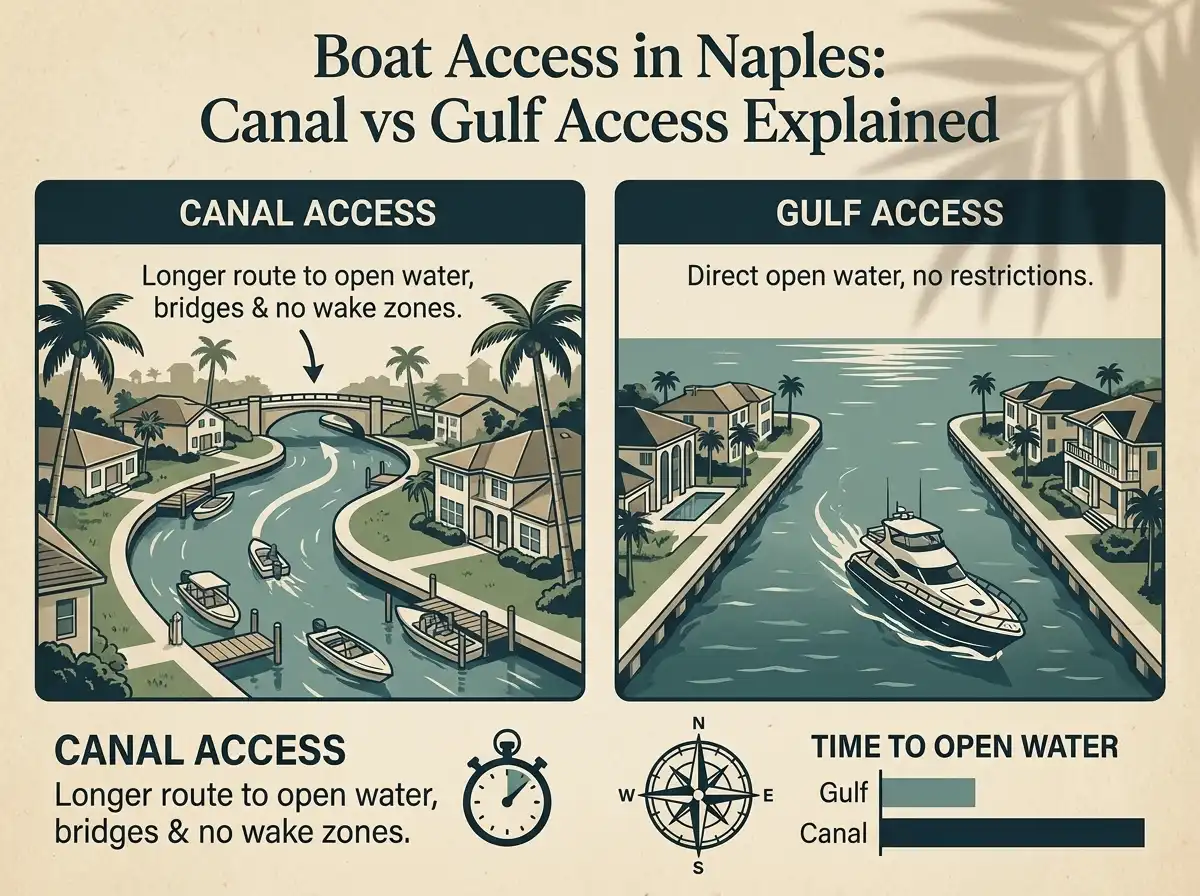
Boat Access in Naples — Canal vs Gulf Access Explained
Two homes can both say "gulf access" in Naples and offer completely different boating experiences. This guide decodes the terminology, explains what actually limits your boat and your route, and gives you the 10 questions to verify before you buy.
The Terminology Problem — Why "Gulf Access" Means Different Things
Naples waterfront listings use terms like "canal access," "gulf access," "direct access," "no bridges," and "sailboat access" as if they are standardized descriptions. They are not. They are marketing language, and two listings using the same phrase can represent waterfront experiences that are functionally worlds apart — one a quick idle out to Naples Bay, the other a 45-minute route through multiple canal systems, speed zones, and a low fixed bridge that eliminates half the boats on the market.
The core confusion is that canal and gulf access are not opposites. Many Naples gulf access homes sit on canals — the canal is simply the neighborhood waterway, and the relevant question is whether that canal connects to Naples Bay and ultimately to the Gulf of Mexico. A home can have beautiful canal frontage and zero practical boating access. And a home with true, unrestricted gulf access may still involve a meaningful canal transit to get there.
The right questions are never "canal or gulf?" — they are: does this canal connect out, through what route, with what restrictions, and can my specific boat make that trip without compromises I am not willing to accept?
The Four Access Categories — What Each Actually Means
| Listing Term | What It Usually Means | What to Verify |
|---|---|---|
| Canal access | Home sits on a canal with a dock or seawall. Canal may or may not connect to Naples Bay. Could be freshwater, saltwater, or brackish. | Does the canal connect out? Where does it exit? Is it navigable year-round at your draft? |
| Gulf access | A water route exists from the dock to the Gulf of Mexico without trailering. Route may include bridges, shallow sections, idle zones, and significant travel time. | Bridge clearances on the route. Time to Naples Bay at idle. Minimum depth at mean low water. Exit point — Gordon Pass, Big Marco Pass, etc. |
| Direct gulf access | Marketing language implying a simpler, more straightforward route — often no fixed bridges. Not a legal or standardized term. | Same as gulf access. "Direct" requires the same verification. Confirm bridge clearances and route time regardless of the adjective used. |
| No bridges / sailboat access | No fixed bridges on the route between dock and open water, or bridge clearance high enough for a sailboat's mast. Implies a taller boat is not restricted. | Confirm the clearance measurement and whether it is measured at mean high water or a different datum. Confirm the full route has no fixed bridges — not just the first stretch. |
What Actually Limits Your Boat — The Four Restrictions
Buyers fixate on whether gulf access exists and often miss the four variables that determine whether their specific boat can use that access comfortably. A route that works perfectly for a 24-foot center console may be completely impractical for a 38-foot sportfish with a tower.
| Restriction | What It Limits | How to Verify Before Buying |
|---|---|---|
| Fixed bridge clearance | Your boat's total height — not length. Includes T-top, radar arch, antennas, Bimini in raised position, outriggers, and any tower. Even one low bridge on the route creates a hard limit on what you can keep at that dock. | Get the clearance number for every fixed bridge on the route, confirmed at mean high water. Measure your boat's total height and add 12–18 inches of margin for comfort and wave action. |
| Water depth / draft | Your boat's running draft at speed and at rest. Canals silt in over time. Some sections are shallower than charted depths, particularly near the edges and at canal junctions. | Ask neighbors what they run and whether low tide is an issue. Request any available dredging history. Visit the property at low tide if possible — conditions at mean low water are what determine your actual operational constraint. |
| Canal width and turning radius | Your boat's overall length. A 40-foot vessel needs a wide canal to turn safely. Some Naples residential canals are too narrow for larger boats to maneuver without neighbor cooperation. | Verify canal width at the dock location. For larger vessels, walk the dock and assess the turning situation — agents can describe it, but seeing it is the only reliable method. |
| Idle and no-wake zones | Your time on the water and patience. Naples canals are predominantly idle speed. Manatee protection zones add enforced no-wake requirements in certain areas and seasons. Long canal routes at idle speed are a daily reality for many waterfront owners. | Ask about the route from dock to open water and where idle speed ends. Time the route on Google Earth or by boat before closing. If a 10-minute estimate is actually 35 minutes at idle, that changes how often you use the boat. |
The Seawall and Dock — The Infrastructure That Costs Real Money
Access terminology dominates waterfront listings, and infrastructure condition gets almost no attention in marketing materials. This is exactly backwards from a financial risk perspective. A seawall at end of life is a five to six figure replacement project. A failing dock with compromised pilings needs full reconstruction. These are not small items, and they are not always visible from a casual showing.
Seawall issues to assess before closing: cap cracks running horizontally along the top of the seawall (vertical cracks are less serious, horizontal cracks indicate bowing or failure); evidence of soil washout behind the wall visible as depressions in the lawn near the seawall; tiebacks showing corrosion or pulling free from the wall face; and differential settlement where sections of the seawall are at different heights. A seawall engineer inspection — separate from the standard home inspection — is the appropriate tool when condition is uncertain.
Dock and piling condition: pilings should be firm with no significant below-waterline deterioration. Marine borers, particularly in saltwater canals, can hollow pilings that look intact above the waterline. A marine contractor or underwater inspection is the correct way to assess piling condition on an older dock. HOA rules in gated waterfront communities also affect what modifications or additions are permitted — verify lift allowances, dock extension permissions, and size restrictions before assuming any particular configuration is possible.
Listing Language Decoded — What Common Terms Actually Signal
Understanding the informal translation layer that experienced Naples agents use when reading waterfront listings saves time and prevents misaligned expectations.
| Phrase in Listing | What It Often Signals | What to Ask |
|---|---|---|
| "Minutes to open water" | Optimistic. "Minutes" is undefined. Could mean 8 minutes to Naples Bay at planning speed, or 35 minutes to Gordon Pass at idle through two canal systems. | Minutes at what speed? Minutes to Naples Bay or to the Gulf? What is the route from dock to Gordon Pass specifically? |
| "Sailboat access" | Usually implies no fixed bridges or very high clearance. Also sometimes signals wider canals and deeper water — conditions favorable to larger vessels generally. | What is the actual clearance number? Is it measured at mean high water? Are there any bridges at all on the route? |
| "Boater's paradise" | Lifestyle marketing. Tells you nothing about the route, restrictions, or infrastructure condition. | Ignore and ask the factual questions independently. |
| "Protected waters" | Canal or bay location that is sheltered from ocean wave action. Relevant for dock protection and comfort at the dock. Does not describe the ease of access to open water. | Useful for understanding dock exposure — ask separately about the route to open water. |
| "Deeded dock" or "deeded boat slip" | Dock ownership or rights are documented in the property deed. Relevant for condos or communities where dock ownership is separate from the unit. | Confirm what is included in the deed and whether the slip size accommodates your vessel. |
Canal-Only Access vs True Gulf Access — Which Buyer Is Which
Not every waterfront buyer needs or wants gulf access. The lifestyle value of canal frontage — the view, the dock, the ability to keep a kayak or paddleboard in the water — is real and significant for a meaningful segment of Naples buyers. Understanding which buyer profile you actually are before you start searching prevents the very common situation where a buyer pursues gulf access homes at a significant premium and then discovers they boat two or three times a year.
- Canal access is the right choice if: you want the waterfront lifestyle — the view, the dock ambiance, easy water access for paddlecraft or a small skiff — and you are comfortable trailering a larger vessel for offshore trips, or you do not plan to keep a large boat at the property.
- Gulf access is necessary if: you intend to keep a boat at the dock and use it regularly for fishing, cruising, or day trips to Keewaydin Island, and you want to leave from your backyard without the logistics of a marina or trailer.
- No-bridge gulf access is worth the premium if: you own or plan to own a vessel with a T-top, tower, radar arch, or fly bridge that exceeds the clearance of any fixed bridge on the standard route — or if you want the flexibility to upgrade to such a vessel in the future without being limited by the property's water access.
The 10 Questions to Ask Before You Buy Any Naples Waterfront Home
These questions should be answered before you make an offer — not during the inspection period after you are already emotionally and financially committed. Your agent should be able to get most of these answers from the listing agent or through direct investigation before the showing ends.
- Is the waterway behind the home saltwater, freshwater, or brackish — and does it connect to Naples Bay and the Gulf?
- What is the exit point to the Gulf — Gordon Pass, Big Marco Pass, or another outlet?
- Are there any fixed bridges on the route between dock and open water? What is the lowest clearance, measured at mean high water?
- What is the minimum depth in the canal at mean low water — not average depth, but the shallowest point between the dock and the open waterway?
- What type and size of vessel do the current owners run, and have they ever had low-tide clearance issues?
- What is the approximate time from dock to Naples Bay at idle speed?
- What is the seawall condition, approximate age, and when was it last professionally inspected?
- What is the dock condition — pilings, decking, cleats, and any existing lift?
- Does the HOA permit boat lifts, and if so, what size or weight limits apply?
- Are there any restrictions on vessel size, type, or overnight docking in the community?
Waterfront Access and Resale Value
True, unrestricted gulf access with no fixed bridges commands a meaningful premium in Naples over canal-only access and over gulf access that involves bridge restrictions. That premium is durable because the supply is genuinely limited — the waterway geography of Naples does not change, and the number of homes with direct, bridge-free gulf access is finite.
However, the premium is only as strong as the documentation behind it. An appraiser evaluating a gulf access home needs to distinguish it from canal-only comparables, and the specific access characteristics — bridge clearances, route time, seawall condition — are the supporting evidence for that distinction. Listings that are imprecise or overstated about access details create appraisal risk, because appraisers will verify what the MLS claims. A listing that claims direct gulf access and actually involves a low fixed bridge will be challenged during the appraisal process, which creates the same problems documented in our appraisals guide.
Sellers of waterfront homes benefit from precise, accurate documentation of access characteristics — not just because it supports the price with appraisers, but because it attracts the right buyer pool. A buyer who discovers mid-contract that their 35-foot boat will not fit under the bridge they were not told about is a buyer who walks or demands a significant credit.
Waterfront homes carry additional ownership costs — seawall maintenance, dock insurance, flood coverage. See the full monthly picture before you commit.
Open CalculatorScott verifies bridge clearances, route times, seawall condition, and HOA dock restrictions on every waterfront showing. Free, no obligation.
Talk to ScottAbout the Author

Scott Cowan Broker / Owner — Realty of Naples FL Scott Cowan is the broker and owner of Realty of Naples FL — a licensed real estate brokerage with offices in Florida, New Jersey, and New York. With nearly 35 years of experience and over $100,000,000 in closed transactions, Scott brings a depth of market knowledge that few Naples agents can match.