
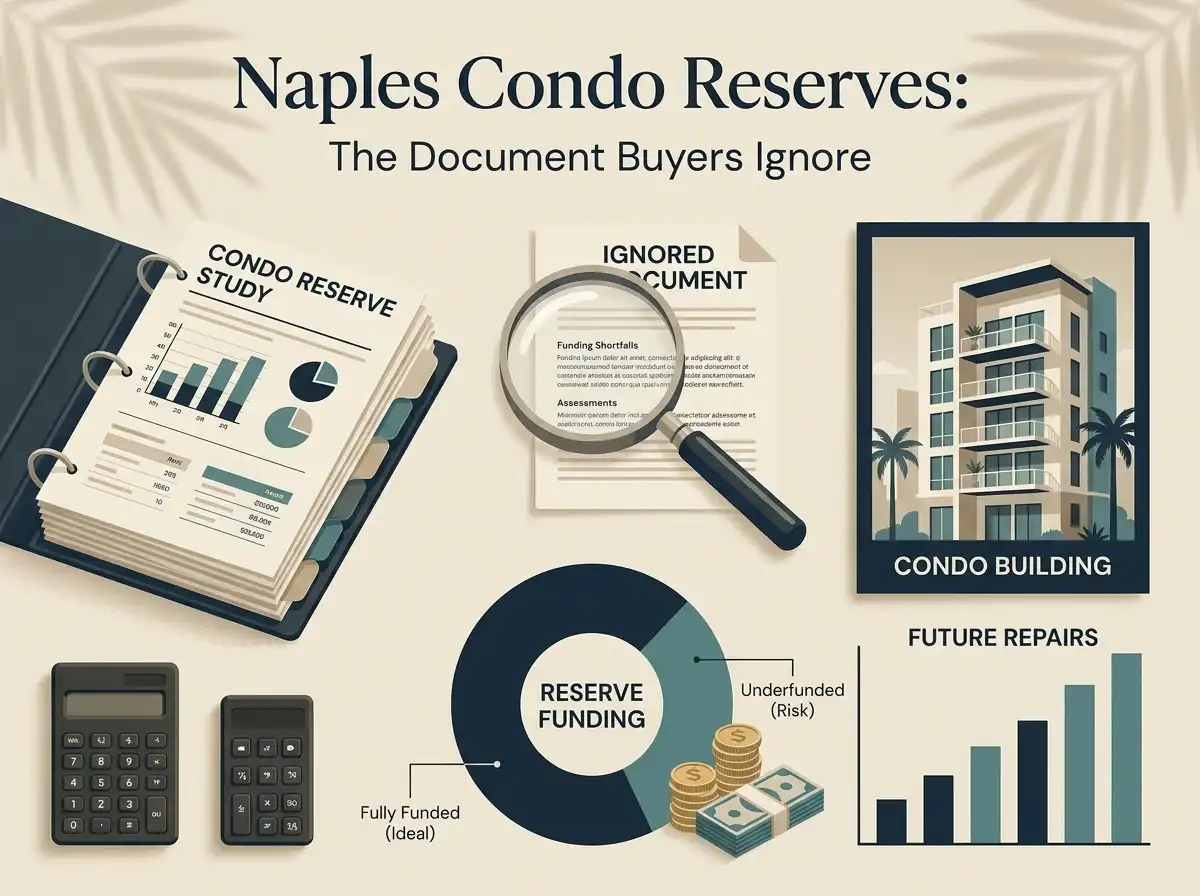
Naples Condo Reserves — The Document Every Buyer Ignores
The warning signs for a five-figure special assessment are almost always sitting in the condo documents. This guide shows you which documents matter, what to look for, and how to read reserve health before you close.
What Condo Reserves Actually Are
Condo reserves are the association's savings account for major future repairs and replacements. Not monthly landscaping. Not pool service. Not cable. Reserves are set aside for the large capital items that wear out over time and cost real money to replace.
In a well-run association, reserves are funded steadily over years so that when the roof hits end of life, the money is already there. No emergency meeting. No special assessment letter. No five-figure bill arriving two weeks after you close.
In an underfunded association, the board is essentially hoping nothing expensive breaks — or, more accurately, pushing the cost of deferred maintenance onto future owners. If you close on a unit in that building, you become one of those future owners.
The major components reserves are meant to cover in a Naples condo:
- Roof replacement
- Elevators and major mechanical systems
- Pool resurfacing and equipment
- Exterior painting and waterproofing
- Paving and site work
- Structural concrete restoration
- Seawalls, docks, and marina infrastructure where applicable
- Plumbing stacks and building-wide systems
Why Buyers Skip This — And Why That's a Problem in Naples
Buyers skip reserve documents for understandable reasons. The review window is short. Life is busy. The reserve study is long, dense, and looks like accounting homework. And when you're emotionally bought in on a unit, you don't want to find something that makes you walk away.
Naples compounds this problem. A large portion of condo buyers here are second-home purchasers or retirees moving from the Northeast, where HOA structures are simpler and reserve requirements are different. Many pay cash, meaning no lender is forcing document scrutiny. And the Naples market has historically moved fast — short review windows mean buyers feel pressure to decide quickly.
The reserve problem is also rarely written in obvious language. It hides in phrases like these in financial documents and meeting minutes:
- "Reserve contributions may be adjusted in the future"
- "The association has elected to waive full funding"
- "Deferred maintenance has been noted"
- "Reserve study is not current"
- "Components funded using a pooled method"
- "Subject to future assessment"
That language is the condo financial equivalent of "we'll figure it out later." Later usually means a special assessment — and by then you own the unit.
The Five Documents That Tell the Reserve Story
You don't need to read every page of every PDF. You need five specific documents and you need to know what to look for in each one.
| Document | What to Look For | Red Flag Language |
|---|---|---|
| Current year budget | Total reserve contributions. What percentage of HOA dues goes to reserves vs. operations. | Reserve line is small relative to building age. "Waived" or "reduced" reserve contributions. |
| Year-end financial statements | Actual reserve account balance. Operating surplus or deficit. Any notes about deferred maintenance or loans. | Reserve balance near zero. Operating deficits. Large payables or outstanding loans not previously disclosed. |
| Reserve study / engineering report | Percent funded. Remaining useful life of major components. Recommended annual contributions. | Below 50% funded is a serious red flag. Below 70% warrants detailed follow-up. Study more than 3–5 years old. |
| Meeting minutes — 12 months minimum | Search for: roof, concrete, leak, engineering, assessment, structural, elevator, insurance, attorney, loan, bids. | Casual mention of upcoming major projects. "Discussing options." "Received bids." "Exploring financing." |
| Capital improvement loan documents | Loan amount, terms, monthly payment, per-unit allocation, and whether obligation transfers to new owner. | Loan exists but wasn't disclosed upfront. Monthly loan payment not reflected in stated HOA fee. |
Meeting minutes deserve the most attention. Boards speak more candidly in minutes than anywhere else. A phrase like "received three bids for roof replacement" or "engineer's report recommends concrete restoration within 18 months" tells you an assessment is loading — even if nothing has been formally approved yet. By the time an assessment appears in the estoppel certificate, it's too late to negotiate around it.
How to Read Percent Funded — and What the Number Means
The reserve study's "percent funded" figure is the single most useful number for a quick read on reserve health. It compares the current reserve balance to what the balance should be if the association had been fully funding its reserves since the building was new.
| Percent Funded | What It Means | Risk Level |
|---|---|---|
| 90–100% | Reserves are healthy. Association has been funding consistently and is in a strong position for upcoming replacements. | Low |
| 70–89% | Reasonable position. Minor catch-up may be needed but no immediate crisis. Standard for many well-run associations. | Moderate |
| 50–69% | Underfunded. Special assessments or significant dues increases are likely within the next 5–10 years depending on upcoming replacements. | Elevated |
| Below 50% | Seriously underfunded. High probability of near-term special assessments, particularly if any major components are approaching end of life. | High |
| Waived / not available | Association has opted out of reserve funding or no current study exists. Treat as high risk until proven otherwise. | Very High |
Percent funded is a directional signal, not a guarantee. A building at 75% funded with a roof replacement due next year is in worse shape than a building at 60% funded with all major systems recently replaced. Use the number as a starting point, then look at the remaining useful life estimates for the most expensive components — roof, elevators, and structural concrete are the three that matter most in Naples.
Why Low HOA Fees Are Sometimes a Red Flag
In Naples, low HOA fees sell units. Buyers highlight them. Agents mention them in listings. They feel like a feature. But low dues can be a symptom of an underfunded building rather than a sign of efficient management.
An association can keep dues artificially low for years by skipping full reserve contributions. The building looks affordable. Then the roof fails, the concrete needs restoration, and the elevator needs modernization — and the money isn't there. Owners get a special assessment. Sometimes multiple, in consecutive years.
The right question is not "how much are dues?" The right question is "what do dues actually cover, and what are we not paying for yet?" A building with higher dues and fully funded reserves is often a safer purchase than one with low dues and a financial shortfall building quietly in the background.
What Underfunded Reserves Cost You as an Owner
Reserve problems don't stay abstract. They show up in your wallet in specific, measurable ways:
- Special assessments — one-time charges that can range from a few thousand dollars to $20,000–$40,000 per unit for major projects
- Rising HOA dues — boards playing catch-up often implement large annual increases that compound over time
- Financing problems — some lenders will not approve mortgages on condos with weak reserve funding, which shrinks your buyer pool when you eventually sell
- Resale price pressure — informed buyers today ask reserve questions. A building with known shortfalls forces price concessions or drives buyers to competing units
- Insurance complications — underfunded buildings often defer maintenance that affects insurance coverage and premium levels
Eight Questions to Ask Before You Write an Offer
These questions can be asked of your agent, the listing agent, or submitted directly to the HOA management company in writing. Written responses create a paper trail that matters if something surfaces after closing.
- Do you have a current reserve study? What year was it completed?
- Are reserves fully funded, partially funded, or waived? What is the current percent funded?
- What is the actual dollar balance in the reserve accounts today?
- What major repair or replacement projects are planned or anticipated in the next 24–36 months?
- Have there been any special assessments in the last five years? If yes, what for and how much per unit?
- Are HOA dues expected to increase materially next year?
- Is there any outstanding loan for capital improvements? If yes, what are the terms and does it transfer to the buyer?
- Has the Milestone Inspection or Structural Integrity Reserve Study been completed? What did it find?
If You Are Selling a Condo With Reserve Issues
Sellers sometimes view reserve problems as the association's issue, not theirs. Buyers don't see it that way. They are buying into the building's financial future, and a sophisticated buyer — or their lender — will find the shortfall in the documents.
The worst outcome is a buyer who discovers reserve problems mid-contract, after they have invested time, inspection fees, and emotional energy. That buyer either walks or demands a significant credit. Getting ahead of it — disclosing the situation early, having documents organized, and pricing accordingly — keeps deals intact and closes faster.
Our 1% listing commission gives sellers more room to negotiate credits or absorb price adjustments when building financials are a factor, without their net proceeds collapsing. A deal that works for both sides is always better than one that falls apart at the document review stage.
HOA fees, CDD, insurance, taxes, and assessment risk — see the full monthly cost of any Naples condo before you make an offer.
Open CalculatorScott reviews HOA financials and reserve documents on any Naples condo before you write an offer. Free, no obligation, 35 years of Naples market experience.
Talk to Scott