
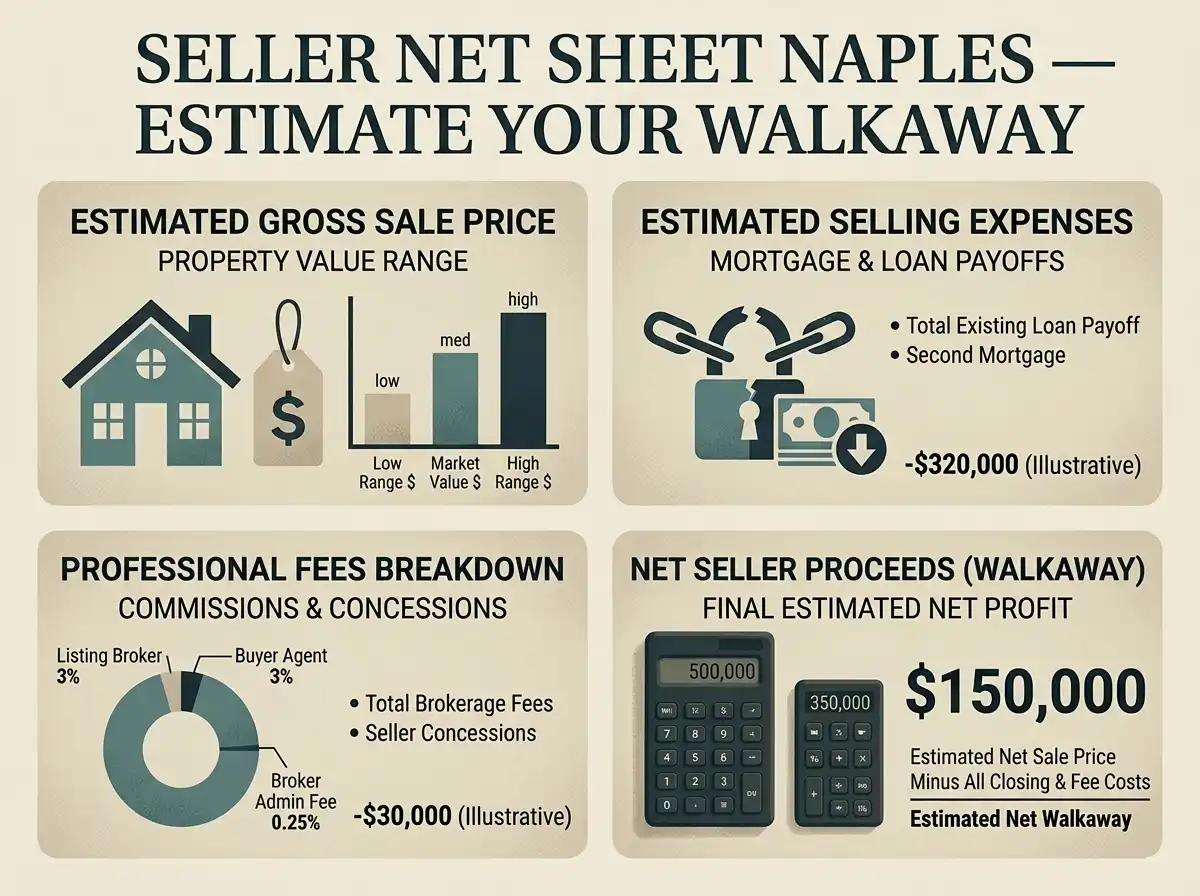
Seller Net Sheet Naples — Estimate Your Walkaway
Before you list your Naples home, you need to know what you actually walk away with — not what it sells for. This guide breaks down every line item on a Naples seller net sheet and shows exactly how our 1% commission changes your bottom line.
What Is a Seller Net Sheet and Why Does It Matter?
A seller net sheet is a line-by-line estimate of what you will receive at the closing table after every cost, fee, and payoff has been subtracted from your sale price. It is not a contract or a guarantee — it is the most important planning document you will produce before listing your Naples home.
In Naples, where home prices regularly exceed $600,000 and the cost structure includes items that are completely foreign to buyers and sellers from the Northeast, this number is not optional. The biggest mistake Naples sellers make is anchoring on the sale price and ignoring the net. A home that sells for $800,000 can net $100,000 less than the seller expected once you account for closing costs, commissions, proration credits, and repair concessions. Running your net sheet before you list closes that gap — in advance, before you have committed to anything.
The second mistake sellers make is not understanding which costs are fixed and which are negotiable. Florida documentary stamp tax, title insurance, and HOA estoppel fees are largely fixed. Commission is not. At Realty of Naples FL, our listing fee is 1%. On a $750,000 home, that single line item puts $37,500 more in your pocket compared to a traditional 6% structure.
Every Line on a Naples Seller Net Sheet
Here is a realistic line-by-line breakdown for a $750,000 Naples home sale under standard Collier County closing customs.
| Line Item | Who Pays | Estimate on $750K |
|---|---|---|
| Sale Price | — | $750,000 |
| Mortgage payoff | Seller | Your current balance |
| Listing commission — Realty of Naples FL | Seller | $7,500 (1%) |
| Doc stamps on deed (0.7%) | Seller | $5,250 |
| Owner's title insurance | Seller (Collier Co. custom) | ~$3,800 |
| Title/settlement fee | Seller | ~$600 |
| HOA estoppel fee | Seller | $100–$500 |
| Property tax proration | Seller credits buyer | Varies by close date |
| Home warranty (optional) | Seller | $400–$700 |
| Buyer repair credits (if any) | Seller | Negotiated |
| Estimated total closing costs | — | ~$18,000–$24,000 |
| Net before mortgage payoff | — | ~$726,000–$732,000 |
The Florida Doc Stamp — What Northeast Sellers Don't Expect
Florida charges documentary stamp tax on the deed at $0.70 per $100 of the sale price. On a $750,000 home that is $5,250. This surprises almost every seller coming from New York, New Jersey, or Connecticut — states where transfer taxes are either paid by the buyer, shared, or structured very differently.
In Florida, the doc stamp on the deed is the seller's responsibility. It is not negotiable — it is a state tax. But it is completely predictable. Multiply your expected sale price by 0.007 and you have your number. Include it in your net sheet from the first conversation, not as a surprise at closing.
Owner's Title Insurance — A Collier County Custom
In Collier County, the seller traditionally pays for the owner's title insurance policy. This is a local custom — in some Florida counties the buyer pays. In Naples, it falls on the seller. The cost is based on the sale price and runs approximately $3,500–$4,500 on a $750,000 transaction. It is a one-time premium that protects the buyer against any title defects that may surface after closing.
This is not a junk fee — it is legitimate closing infrastructure. But it is also a seller cost that many out-of-state clients do not anticipate. Your net sheet should include it from day one.
HOA Estoppel Fees
If your Naples home is in a gated community — and the overwhelming majority are — your HOA must produce an estoppel certificate before closing can proceed. This document confirms that dues, assessments, and fees are current and that there are no outstanding violations or pending special assessments. The HOA charges for producing it.
Fees range from $100 to $500 depending on the management company. Some communities charge rush fees if the closing timeline is tight. Budget for it. It is predictable, small in the context of a $750,000 transaction, but it belongs on your net sheet.
Three Scenarios: How Pricing Sensitivity Affects Your Net
The most useful seller net sheet is not one number — it is three. Running your walkaway at your target price, at a 4% reduction, and at an 8% reduction shows you exactly how much pricing risk you are carrying. In the 2026 Naples market, where inventory has expanded and days on market have lengthened, this scenario planning is not optional — it is essential.
| Scenario | Sale Price | Realty of Naples Fee (1%) | Other Closing Costs | Est. Net |
|---|---|---|---|---|
| Target price | $800,000 | $8,000 | ~$10,500 | ~$781,500 |
| Most likely | $750,000 | $7,500 | ~$9,900 | ~$732,600 |
| Price reduced | $700,000 | $7,000 | ~$9,300 | ~$683,700 |
Notice how our 1% listing fee scales proportionally — and stays small at every price point. The difference in net between target price and a price-reduced outcome is approximately $98,000. That is the cost of overpricing, not of commission. Correct pricing in the first 30 days of Naples peak season is worth far more than any commission negotiation.
Property Tax Prorations
Florida property taxes are paid in arrears. The 2026 tax bill is paid in November 2026 for the entire calendar year. If you close in April, you owe the buyer a credit for the January–April portion of 2026 taxes, even though that bill has not been issued yet. The proration is calculated using the prior year's tax bill divided by 365, multiplied by your days of ownership in the current year.
On a $750,000 Naples home with an annual tax bill of approximately $7,500, an April closing produces a tax proration credit of roughly $2,500 to the buyer. It is not a large number on a $750,000 transaction, but it belongs on your net sheet and it varies by close date. Closing in January versus closing in October produces meaningfully different proration credits — worth knowing before you negotiate a closing date.
Repair Credits and Buyer Concessions
In the current Naples market, inspection requests are more substantive than they were during the 2021–2022 seller's market. Buyers have more inventory to choose from, more time to negotiate, and more leverage during the inspection period. A realistic seller net sheet in 2026 should include a contingency line for buyer credits.
A conservative planning figure is 1–2% of the sale price — $7,500 to $15,000 on a $750,000 home. You may not use all of it. But if you don't budget for it and a buyer comes back with an $11,000 inspection credit request, your net sheet looks very different from what you planned.
- Roofs over 15 years old are the most common inspection trigger in Naples — insurance underwriters flag them too
- HVAC systems over 10 years are routinely flagged — buyer credits of $3,000–$8,000 are common
- Pool equipment issues, seawall condition, and dock permits are Naples-specific items that rarely appear in Northeast transactions
- Closing cost credits have become increasingly common — some buyers negotiate $10,000–$20,000 toward their own closing costs as part of the offer
How to Use Your Net Sheet Before You Set a List Price
Most sellers build a net sheet after they receive an offer. That is the wrong time. Build it before you set your list price and before you sign a listing agreement. A pre-listing net sheet lets you work backwards from your financial goal. If you need to net $550,000 to pay off your mortgage and fund your next purchase, the net sheet tells you exactly what sale price produces that outcome after all costs — not what you hope it produces.
Run the calculator using your actual mortgage payoff figure — request a 10-day payoff statement from your lender before you list. Use our 1% listing fee. Plug in an estimated proration based on your target close date. Add a 1.5% contingency for potential inspection credits. The number you get is a real planning figure, not a guess.
The Closing Disclosure — Your Final Net Sheet
Your seller net sheet is an estimate. The document that locks in every number is the Closing Disclosure (CD), which your title company produces approximately 1–2 weeks before closing. Every line on the CD should match your net sheet estimate. If it doesn't — if a fee has changed, a proration was calculated differently, or a credit was missed — that discrepancy needs to be caught before closing day, not discovered at the table.
Scott reviews the Closing Disclosure with every Realty of Naples FL seller before closing. This is not a formality — it is how we protect your net. Numbers that don't match get corrected before you sign.
Enter your sale price, mortgage balance, and close date. See your full walkaway estimate in under 60 seconds.
Open Net Sheet CalculatorKnow your price before you run your numbers. Scott provides a data-driven Naples valuation — no algorithms, no obligation.
Request a Free ValuationAbout the Author

Scott Cowan Broker / Owner — Realty of Naples FL Scott Cowan is the broker and owner of Realty of Naples FL — a licensed real estate brokerage with offices in Florida, New Jersey, and New York. With nearly 35 years of experience and over $100,000,000 in closed transactions, Scott brings a depth of market knowledge that few Naples agents can match.