
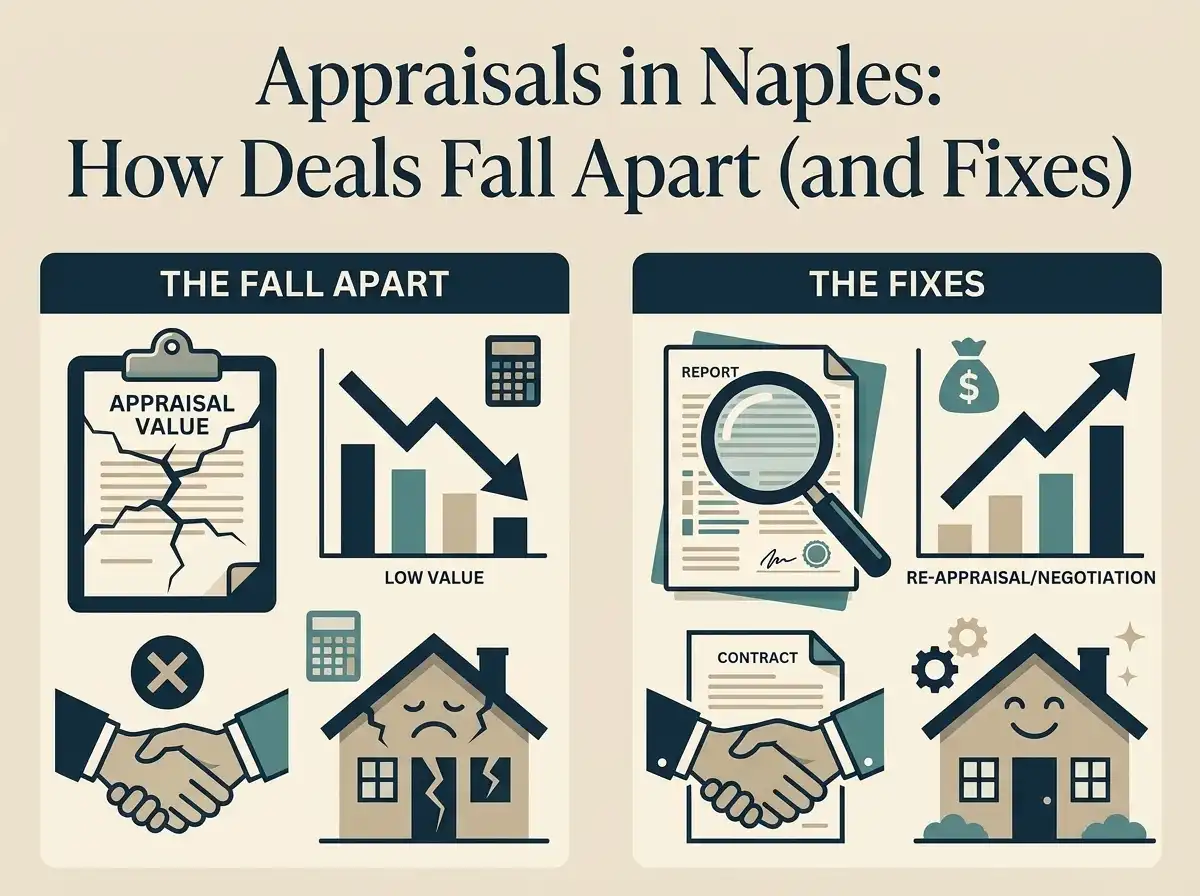
Appraisals in Naples — How Deals Fall Apart and How to Fix Them
A low appraisal does not have to kill a Naples deal. This guide covers the five ways appraisals create problems in Collier County, what your real options are when the number comes in short, and how to prevent the problem before it starts.
What a Lender Appraisal Actually Is — and What It Is Not
A lender appraisal is ordered by the bank, not the buyer or seller, for one purpose: to confirm that the property used as loan collateral is worth at least the amount being lent against it. The appraiser is working for the lender, not for either party in the transaction. Their job is to protect the bank's position — not to validate the contract price or reflect what the market feels like today.
Appraisers work from a standardized methodology: they identify recent closed comparable sales, make adjustments for differences in size, condition, location, and features, and arrive at a supportable value. In Naples, where two adjacent streets can represent meaningfully different markets — different HOA structures, different waterfront access, different community amenities — the "comparable" selection is the most consequential and most contested part of the process.
What an appraisal is not: it is not a home inspection, not a guarantee of market value, and not a real-time reflection of buyer competition. A home that attracted four competing offers at $925,000 can still appraise at $885,000 if the closed sales used as comparables reflect a market from 90 days ago.
The Five Ways Appraisals Break Naples Deals
| Problem | Why It Happens in Naples | How Often It Kills the Deal |
|---|---|---|
| Appraised value below contract price | Comp lag in fast-moving pockets. Renovated homes with dated comparables. Niche neighborhoods with few recent sales. | Most common — but usually fixable |
| Wrong neighborhood comparables | Appraiser pulls technically nearby but functionally different comps — different HOA, different waterfront type, different community tier. | Fixable via ROV with better data |
| Lender condition requirements | Roof age, peeling paint, missing handrails, active leaks, electrical issues. These are lender risk requirements — not always aligned with what buyer and seller see as dealbreakers. | Usually fixable fast if addressed immediately |
| Condo project approval failure | HOA reserve shortfall, pending litigation, high investor ownership ratio, insurance gaps. The appraisal value is fine but the project fails lender approval standards. | Harder — may require different loan type or cash |
| Comp lag in a shifting market | Closed sales are backward-looking. In a rising market, comps are stale low. In a cooling market, comps are stale high. Either creates a disconnect with current contract prices. | Manageable with strong comp package |
The Comp Lag Problem — Why Naples Is Especially Vulnerable
Appraisers are required to use closed sales as comparables — not active listings, not pending contracts, not what a knowledgeable local agent believes the market will produce next month. Closed sales are backward-looking by definition. In a Naples market that moves quickly, the most recent closed comparable may be 60 to 120 days old, and in a rising price environment, that gap represents real money.
This creates a structural tension: buyers compete against each other in real time and push prices to a level that reflects current demand, while the appraiser is required to justify that price with evidence from a market that existed three to four months ago. When the gap between those two realities is large — as it has been in Naples during peak demand periods — appraisals come in low not because the property is overpriced, but because the supporting data is lagged.
The same problem runs in reverse in a cooling market. If prices have softened but the most recent closed sales still reflect the stronger months, appraisals can come in at or above contract price even when buyers feel they are negotiating from strength. Understanding which direction the lag is running — and by how much — is part of what Scott evaluates before pricing any Realty of Naples FL listing.
When the Appraisal Comes In Low — All Six Options
A low appraisal is not a dead end. It is a decision point. Every party has real options, and the best outcome depends on which option aligns with the financial position and motivation of each side. The worst outcome is stalling — appraisal problems that sit unaddressed for a week while emotions escalate and timelines compress.
| Option | How It Works | When to Use It |
|---|---|---|
| Buyer covers the gap | Buyer pays the difference between appraised value and contract price out of pocket. Loan is based on appraised value; buyer brings additional cash to closing. | Buyer has reserves, wants the property, gap is manageable relative to purchase price. |
| Seller reduces price | Seller accepts the appraised value as the new contract price. Buyer proceeds with original loan structure. | Seller is motivated to close, has flexibility in net proceeds, or has no backup offers. |
| Split the gap | Buyer covers part of the shortfall, seller reduces price for the remainder. Most common negotiated resolution. | Both sides want the deal to close and the gap is small enough to share without pain for either party. |
| Reconsideration of value (ROV) | Buyer's lender submits a formal challenge to the appraiser with additional comparable sales or corrections to property data errors. | Appraiser missed a strong comparable, made adjustments that are internally inconsistent, or recorded property facts incorrectly. |
| Second appraisal / new lender | Buyer switches lenders, triggering a new appraisal assignment. New appraiser may reach a different conclusion. | ROV was unsuccessful, buyer believes the value is genuinely supportable, and timeline allows for the additional delay. |
| Cancel | If appraisal contingency is in place and neither party will move, buyer invokes the contingency and recovers deposit. | Gap is too large, neither side will negotiate, or property condition issues make the deal unworkable regardless of price. |
The Reconsideration of Value — When It Works and When It Doesn't
A reconsideration of value (ROV) is a formal request submitted through the buyer's lender asking the appraiser to reconsider their conclusion in light of additional evidence or identified errors. It is not a complaint, and it is not a negotiation — it is a factual submission. Appraisers take them seriously when the evidence is strong, and dismiss them when the only argument is "the market is hot."
An ROV is worth pursuing when any of the following are true: the appraiser missed a directly comparable closed sale that supports a higher value and falls within standard distance and time guidelines; the adjustments applied are internally inconsistent — for example, the appraiser applied a $10,000 pool adjustment in one comp and a $35,000 pool adjustment in another with no documented explanation; the appraiser recorded a factual error in the subject property — wrong gross living area, incorrect bedroom count, wrong waterfront classification; or the appraiser used comps from a functionally different neighborhood when equivalent comps existed in the same community.
An ROV is unlikely to succeed when the only new evidence is active listings rather than closed sales, when the argument is essentially "other buyers would pay more," or when the gap between the appraised value and the contract price is large enough that no single comparable would bridge it. In those cases, negotiation between buyer and seller is the more productive path.
Lender Condition Requirements — The Fixable Appraisal Problem
A lender condition requirement is different from a low value. It means the appraiser has flagged a property condition issue that the lender requires to be remediated before the loan will fund — regardless of whether buyer and seller consider it significant. These are risk management requirements from the lender, not judgments about the property's quality.
Common condition calls in Naples transactions include: roofing with visible deterioration or estimated remaining life below lender thresholds; peeling exterior paint or rotted wood trim (particularly relevant on older homes); missing or damaged safety features such as handrails, smoke detectors, or GFCI outlets; evidence of active water intrusion or staining that suggests ongoing leaks; and electrical systems with exposed wiring or obsolete panel types that some lenders flag automatically.
The fix for most condition requirements is fast action. Get a contractor quote within 48 hours. Photograph the remediated item. Submit documentation to the lender. Many condition calls are resolved in days. The deals that fail over condition issues are almost always the ones where the response was slow, adversarial, or left uncoordinated between buyer, seller, and their respective agents.
Condo Project Approval — The Appraisal Problem That Isn't the Appraisal
Naples has one of the largest condo markets in Florida, and condo transactions can fail at the appraisal stage for a reason that has nothing to do with value: the project itself fails lender approval standards. Fannie Mae, Freddie Mac, FHA, and individual lenders each maintain standards for condo project approval that go beyond the appraised value of an individual unit.
A condo project can fail approval because: reserve funding is below lender thresholds — Fannie Mae requires at least 10% of the association's annual budget allocated to reserves; pending litigation involving the association exceeds certain thresholds; the percentage of units owned by investors exceeds allowable limits for certain loan types; the building's master insurance policy has gaps or inadequate coverage limits; or a significant pending special assessment has not been resolved.
When this happens, the deal cannot proceed with that loan type regardless of the appraised value or the financial strength of the buyer. The options are: find a lender that uses portfolio underwriting rather than agency standards; restructure to a loan type with more flexible project approval criteria; or use cash. Sellers listing a condo in a building with known project approval challenges need to factor this into their buyer pool expectations and pricing strategy from the start.
What to Include in an Appraiser Packet
Providing a well-organized packet to the appraiser at the time of the property inspection is standard practice for any agent who understands the appraisal process. You cannot instruct an appraiser on their methodology — but you can ensure they have complete, accurate information about the subject property and the best available comparable sales.
- Improvement and upgrade list: itemized list of renovations with approximate dates and costs — roof replacement, impact windows, kitchen and bath updates, HVAC replacement, flooring, pool equipment.
- Curated comp list: 3–5 closed sales that best support the contract price, with a brief note on why each is relevant. Closed sales within the past 6 months, within reasonable distance, in the same or comparable community tier.
- Multiple offer documentation: if the home generated competing offers, some lenders permit this to be shared with the appraiser as evidence of market demand. Confirm with the lender before including.
- Waterfront and view detail: specific documentation of Gulf access, boat lift capacity, seawall condition and age, elevation certificate if available — all items that appraisers must make value adjustments for and benefit from having precisely documented.
- HOA information for condos: current dues, reserve balance, amenities, recent capital improvements to common areas. Helps the appraiser distinguish the subject building from superficially similar alternatives that may have weaker financials.
Negotiating Through a Low Appraisal Without Losing the Deal
The psychology of appraisal renegotiation matters as much as the math. Both buyer and seller are already emotionally invested — the buyer wants the home, the seller has been counting on a specific net. A low appraisal lands in that context as a disruption, and how each agent manages the conversation in the first 24 hours determines whether the deal survives.
Practical approach: confirm the appraised value immediately and in writing — do not rely on verbal reports. Assess the buyer's cash position quickly and without accusation — can they cover a gap if needed? Present concrete resolution options, not a demand. A menu of solutions ("here are three ways we can close this") lands differently than "the price needs to come down." Keep timelines tight. Appraisal problems that sit unresolved for more than 48–72 hours tend to calcify into positions rather than resolving into deals.
For sellers with backup offers: that information changes your leverage, but it needs to be used carefully. A measured, factual acknowledgment that other interest exists and that you prefer to make the current deal work is more effective than using a backup as a threat. Escalation at this stage costs deals that would otherwise have closed.
If a price adjustment is on the table, see exactly what it does to your walkaway before you negotiate. Run any scenario in under 60 seconds.
Run Your Net SheetScott prepares a comp package and appraisal risk review before every listing goes live — not after the problem hits. Free, no obligation.
Talk to Scott