
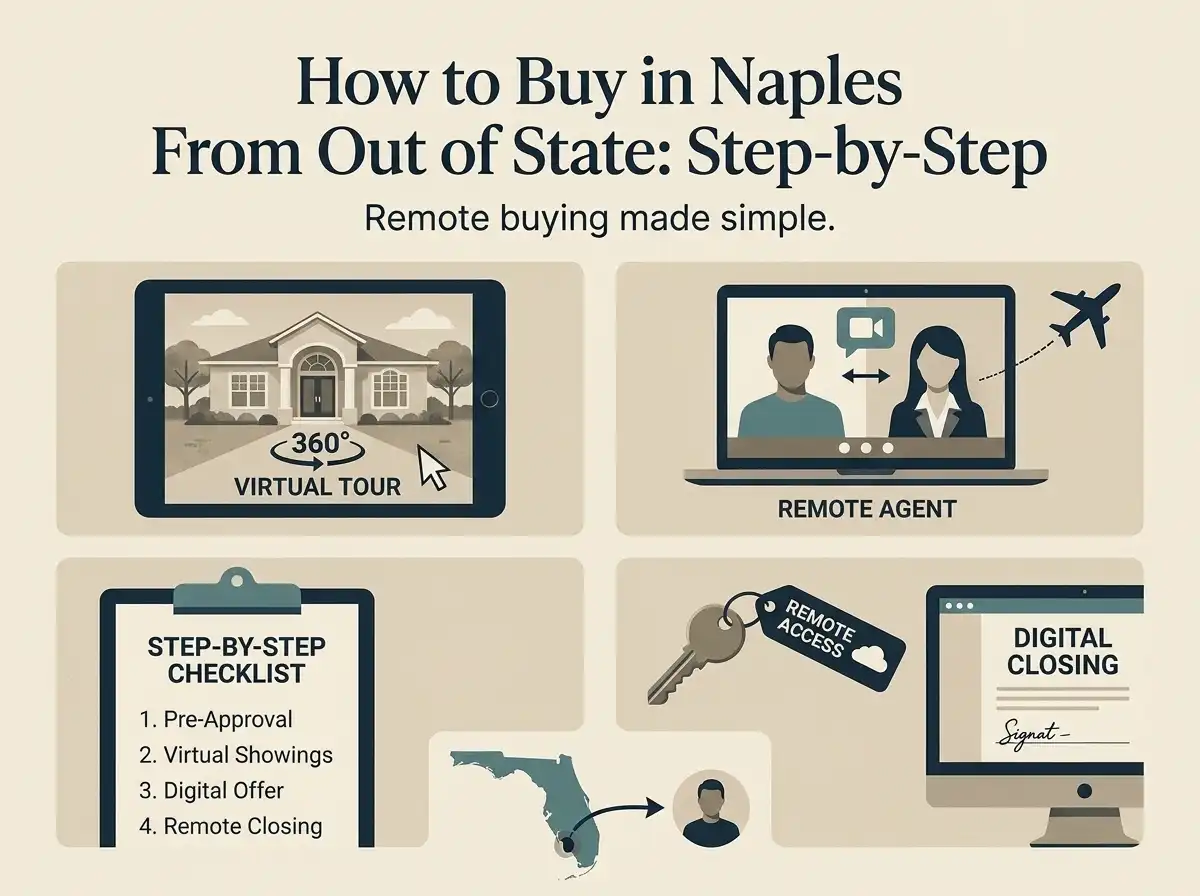
How to Buy in Naples From Out of State — Step by Step
Most Naples buyers are coming from New York, New Jersey, Connecticut, or another Northeast state. This guide covers the complete out-of-state buying process — from neighborhood selection and remote tours to Florida-specific due diligence items that catch out-of-state buyers off guard.
Why Out-of-State Naples Purchases Are Different
The majority of Naples home buyers are arriving from somewhere else — primarily the Northeast corridor from Boston down through New York, New Jersey, Connecticut, and Pennsylvania. Many are buying a second home or investment property before they ever relocate permanently. Some are making a purchase decision based on a week or two of in-person visits and months of online research. Almost all of them are encountering Florida-specific costs, processes, and property considerations that do not exist in their home state.
The out-of-state purchase challenge is not that the process is complicated. It is that the information gap is large. Florida documentary stamp taxes, HOA estoppel certificates, condo reserve requirements, 4-point insurance inspections, flood zone classifications, and hurricane preparedness infrastructure are all normal parts of a Naples transaction — and completely foreign to a buyer from Connecticut who has purchased three homes in their life and never encountered any of them.
This guide addresses that gap step by step. Each section covers both the universal process steps and the Florida-specific items that out-of-state buyers most consistently miss.
Step 1 — Define What Naples Actually Means to You
Naples is not a single market. It is a collection of distinct submarkets that feel, price, and function very differently from one another. A buyer looking for walkable beach access and Old Naples charm is looking at a fundamentally different product than a buyer seeking a newer gated golf community east of I-75. Both are "Naples" — but the properties, the lifestyle, the price points, and the buyer pools at resale are not comparable.
Before your agent can show you anything useful, the following questions need answers — even preliminary ones:
- Purchase purpose: second home, primary residence, investment rental, or retirement transition?
- Rental intent: will you rent it seasonally, long-term, or never? HOA rental rules vary enormously and some communities prohibit short-term rentals entirely.
- Community type: gated golf community, waterfront, beach-adjacent, master-planned non-golf, or in-town walkable?
- Maintenance tolerance: single family home with a yard and pool, or low-maintenance condo or villa with HOA-managed exteriors?
- Timeline: buying this season, planning for next year, or exploring with no fixed deadline?
Honest answers to these questions narrow your search from several hundred possible neighborhoods to a manageable shortlist. Without them, your agent is guessing and your remote research time is largely wasted.
Step 2 — Engage a Local Agent Before You Fall in Love With Zillow
Online listing platforms show you what sellers want you to see. Photos are professionally staged and shot with wide-angle lenses that make rooms appear larger than they are. Descriptions are marketing copy. Days on market figures can be artificially reset if a listing is pulled and relisted. Price history context — whether a reduction reflects a motivated seller or an overpriced start — is invisible without local knowledge.
A local Naples agent provides the layer of information that listing platforms cannot: which streets back up to commercial areas or highway noise, which communities have pending special assessments that have not yet been publicly announced, which buildings have condo financing issues that will affect your loan options, and which neighborhoods have had accelerating or decelerating price momentum in the most recent 60 days.
The right time to engage a local agent is before you have a specific home in mind — not after you have already spent three weeks building an emotional attachment to a property that has a structural problem or an undisclosed HOA issue. An early introductory call with Scott costs nothing and typically saves weeks of misdirected search time.
Step 3 — Nail Down Financing or Proof of Funds Before You Tour
The best Naples listings do not sit. During peak season — November through April — well-priced homes in desirable communities can go from listed to multiple offers within 72 hours. An out-of-state buyer who is not financially prepared will consistently lose to local or better-prepared remote buyers who can act immediately.
For buyers using financing, the appropriate preparation level is a fully underwritten pre-approval — not a pre-qualification based on a brief conversation and a credit pull. A fully underwritten approval means your lender has reviewed tax returns, pay stubs, bank statements, and employment documentation. The only remaining condition is a satisfactory appraisal of the subject property. That document gives your offer the credibility of a near-cash position.
Florida-specific financing considerations that out-of-state buyers frequently miss:
- Condo project approval: many lenders require Fannie Mae or Freddie Mac project approval for condo purchases. Some Naples buildings do not qualify due to reserve levels, investor concentration, or pending litigation. Confirm your lender's condo approval requirements before selecting a building.
- Second home vs investment property: lenders treat these differently — interest rates, down payment requirements, and reserve requirements vary. Clarify your intended use with your lender before the pre-approval is issued, not after you are under contract.
- Jumbo loan requirements: many Naples price points require jumbo financing. Jumbo loans have stricter documentation requirements and a smaller lender pool. Start this process earlier than you think you need to.
Step 4 — Build a Tiered Wish List, Not a Fixed Requirement List
Out-of-state buyers often arrive with a rigid requirement list built from months of online browsing. The problem is that no real market delivers exactly what you designed on a listing platform. An overly rigid list means every property feels like a compromise — which creates decision paralysis and missed opportunities.
A tiered approach is more effective. Before your agent starts showing you properties, categorize your priorities into three tiers:
| Tier | Category | Examples |
|---|---|---|
| Tier 1 — Non-negotiable | Items that cannot be compromised. If a property fails these, do not tour it. | Budget ceiling. Rental allowance (yes/no). Must be gated or must not be gated. Primary school zone if applicable. West of I-75 if location matters. No age restrictions if they apply. |
| Tier 2 — Strong preference | Items that heavily influence your decision but can be traded off against other factors. | Pool. Single story. Water or golf view. Newer roof (within 10 years). 2-car garage. Specific community for golf membership access. |
| Tier 3 — Nice to have | Items that add value but will not drive the final decision. | Outdoor kitchen. Extended lanai. Guest suite layout. Corner lot. Den or bonus room. Electric vehicle charging. |
Share this tiered list with Scott before your first remote tour session. It allows him to filter efficiently and spend your time on properties that are genuinely worth your attention — not ones that look good online but fail a Tier 1 criterion.
Step 5 — Remote Touring Done Right
Photos tell you what a home looks like on its best day. A live video walkthrough tells you significantly more. For out-of-state buyers who cannot casually drive by a neighborhood, remote touring is where the information gap either closes or stays wide open.
What to request from your agent on every remote tour session:
- Live video walkthrough — not a pre-recorded clip. Real-time allows you to ask questions mid-tour and direct attention to specific features.
- Exterior pan including the street view, neighboring properties, and any visible infrastructure (power lines, roads, commercial buildings).
- Sound check — windows open, agent stands still. Road noise, construction, or air conditioning unit noise are not visible in photos.
- Community common areas — pool, clubhouse, fitness center, gate entry. These are part of what you are buying and are often not shown in listing photos.
- Roof condition — a quick exterior view that shows shingle condition and any visible issues. Roof age and condition significantly affect both insurance cost and negotiation leverage.
When comparing multiple properties remotely, establish a consistent format — same sequence of shots, same questions asked on every tour — so your comparisons are meaningful rather than impression-based.
Step 6 — Plan One Efficient In-Person Trip
Fully remote purchases happen, and they can work. But a single well-structured in-person trip dramatically reduces both the risk of buyer's remorse and the information gaps that remote touring cannot fully close. The goal is not to browse — it is to decide. Browsing trips produce confusion. Decision trips produce contracts.
| Day | Activity | Goal |
|---|---|---|
| Day 1 | Tour 6–8 properties across 2–3 target communities. Drive each neighborhood morning and evening to assess traffic and atmosphere. | Narrow from shortlist to top 2–3 properties. Eliminate anything that did not survive in-person inspection. |
| Day 2 | Revisit top 2–3 properties. Drive surrounding area. Check proximity to groceries, medical, beach access, and any other lifestyle priorities. Visit competing communities if still deciding between areas. | Make a final property decision. Be ready to authorize an offer before you leave. |
| Day 3 (optional) | Inspection-style revisit on your chosen property. Measure rooms, check storage, assess natural light at different times, verify parking and guest access. | Eliminate any remaining uncertainty before the offer is submitted. |
Book the trip during peak season — November through April — if your timeline allows. This is when Naples inventory is highest and you can compare the most options. If you are buying in a school-zone-sensitive neighborhood, the February through April window is when family buyer competition is most intense and when you most need to be prepared to move quickly.
Step 7 — Florida-Specific Due Diligence Items Out-of-State Buyers Miss
Florida real estate has several standard due diligence items that do not exist in most northeastern states and that out-of-state buyers consistently underestimate or discover too late in the process.
| Item | What It Is | Why It Matters |
|---|---|---|
| 4-point inspection | Insurance-required inspection covering roof, electrical, plumbing, and HVAC systems on older homes. | Required by many Florida insurance carriers for homes over 10–15 years old. Failures can result in coverage denial, significant premium increases, or requirements to repair before coverage binds. Schedule early — not in the final week of the inspection period. |
| Wind mitigation inspection | Documents hurricane-resistant construction features — roof shape, roof-to-wall connections, opening protection. | Can produce significant insurance premium discounts. Credits vary by carrier and construction type. Worth completing on any home where you intend to obtain Florida homeowners insurance. |
| Flood zone classification | FEMA flood zone designation for the specific property address. | Determines whether flood insurance is required by your lender and what it costs. Standard homeowners insurance does not cover flood damage. Some Naples locations carry significantly higher flood insurance costs than comparable properties in lower-risk zones. |
| HOA financial review | Reserve study, budget, financial statements, and meeting minutes for any community with an HOA. | Reserve shortfalls, pending special assessments, and deferred maintenance are financial liabilities that transfer to the new owner. Critical for condos — see our condo reserves guide for detail. |
| CDD fees | Community Development District fees — a separate annual assessment common in newer master-planned Naples communities. | CDDs fund infrastructure construction and carry a bond component that appears on property tax bills. They are not HOA fees and do not disappear when the community matures. Must be included in your monthly cost calculation. |
| HOA rental rules | Restrictions on minimum lease length, annual rental frequency, and short-term rental platforms. | Many Naples communities prohibit rentals shorter than 30 days, 90 days, or 6 months. Some restrict total annual rental periods. If you plan to generate rental income, verify the specific rules before making an offer — not during condo doc review. |
Step 8 — Make an Offer Built for the Naples Market
Naples offer strategy varies by property type, community, season, and seller motivation. An out-of-state buyer who applies the same approach they used in a New Jersey suburban transaction will consistently underperform — either leaving money on the table in a negotiable situation or losing to competitors in a multiple-offer situation.
Before Scott submits any offer for a Realty of Naples FL buyer, he calls the listing agent to understand what the seller actually cares about — close date flexibility, certainty of close, specific contingency concerns, or timeline alignment with another purchase. That conversation shapes the offer structure. In Naples, the offer that wins is rarely just the highest price. It is the offer that addresses the seller's specific situation most completely.
Key offer elements that out-of-state buyers often handle incorrectly: inspection period length (10–15 days reads as hesitant in a competitive market; 5–7 days with a prepared inspector lined up reads as serious); earnest money deposit (1% is standard, 2–3% signals commitment; in luxury situations higher deposits paired with clean terms are competitive); and closing date (naming a specific date agreed with your lender and title company is stronger than "approximately 30 days").
Step 9 — Inspections for Florida Properties
Florida's climate — sun, humidity, salt air, storm cycles — affects homes differently than northeastern climates. The inspection items that matter most in Naples are often different from what out-of-state buyers have experienced in prior purchases.
- Roof condition and age: the single most important inspection item in Naples. Insurance underwriters in Florida flag roofs over 10–15 years for coverage issues or premium surcharges. A roof replacement costs $15,000–$40,000 depending on size and material. Never skip a dedicated roof inspection.
- 4-point inspection: complete this during the inspection period, not after. Electrical panel type (Federal Pacific and Zinsco panels are flagged by many carriers), plumbing material (polybutylene piping is a coverage issue), and HVAC age all affect insurability.
- Hurricane impact protection: impact windows, doors, and shutters affect both insurance cost and storm preparedness. Verify what is present and whether it meets current standards.
- Pool and pool equipment: pools are standard in Naples. Equipment age, condition, and any existing violations are worth verifying — particularly heaters, pumps, and automation systems.
- For condos — document review: condo document review during the inspection period is not optional. Reserve funding, special assessments, HOA litigation, and building insurance coverage are all material to the value of what you are buying. See our condo reserves guide and special assessments guide for detail.
Step 10 — Insurance: Start This Earlier Than You Think
Florida homeowners insurance is not interchangeable with insurance in northeastern states. The carrier landscape is different, the underwriting criteria are stricter, and the premium levels are significantly higher — particularly for properties in flood zones, properties with older roofs, and properties without impact-rated window and door protection.
The most common out-of-state buyer mistake: treating insurance as a final-week closing task. In Florida, insurance quotes should be obtained in the first week of the inspection period. Discovering in week three that the property has an uninsurable roof or an unacceptable flood zone designation creates a crisis at a point when your inspection contingency may have already expired.
For properties in certain coastal Naples zip codes, it is worth getting insurance quotes before making an offer — particularly if flood insurance cost is material to your monthly payment calculations. A $500/year homeowners insurance cost from your prior state can become $8,000–$15,000/year in coastal Southwest Florida, and that changes the affordability math significantly.
Steps 11 and 12 — Closing and Post-Closing Setup
Out-of-state closings in Florida are logistically straightforward. Florida allows remote online notarization (RON), which means you can close from anywhere with a computer and a notary connection. Mail-away closings with overnight document packages are also standard. If you prefer to be present in person, the title company will accommodate a table closing — but it is not required.
Pre-closing logistics to confirm in advance: how keys and community access devices (gate clickers, amenity fobs) will be transferred; whether final walk-through will be attended by you in person or conducted by your agent with video documentation; utility transfer timing and which accounts to establish before closing day.
Post-closing setup for out-of-state owners — whether second home or rental — should be organized before you close, not after:
- Local property manager or trusted handyman contact for maintenance issues you cannot address remotely
- Smart lock or keypad entry system so access can be managed without physical key exchanges
- AC maintenance schedule — Florida air conditioning runs year-round and requires quarterly filter changes and annual service minimum
- Pest control quarterly service — standard for Florida homes, not optional
- Hurricane preparedness plan — shutter or impact protection procedure, storm supply checklist, property check contacts if a named storm threatens during a period when you are not in residence
- Insurance and policy documents saved in a cloud location accessible from anywhere
Comprehensive guide to moving to Naples from the Northeast — neighborhoods, costs, taxes, lifestyle, and what to expect in year one.
Read the GuideScott has guided hundreds of Northeast buyers through the Naples purchase process. One call closes most of the information gap. Free, no obligation.
Talk to Scott